The Great Arch — A Monument to Vision, Ego, and the Cost of Perfection
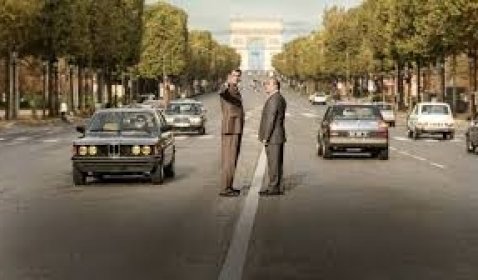
There is something inherently cinematic about watching a great building being imagined before it exists. Ideas become drawings, drawings become arguments, and eventually those arguments have to survive the messy realities of money, politics and human compromise. The Great Arch understands that tension, turning the construction of one of Paris's most recognisable modern monuments into a quiet drama about what happens when artistic purity meets the real world.
Directed by Stéphane Demoustier, the film follows Johan Otto von Spreckelsen, the relatively unknown Danish architect who wins the competition to design the Grand Arche at La Défense. His vision is strikingly simple: a monumental hollow cube, precise in its proportions and deliberately different from the grand historical architecture surrounding Paris.
Claes Bang plays Spreckelsen as a man who seems almost physically uncomfortable with compromise. His design is not simply a project to him. It is an idea that he believes must be protected in its original form, even when government officials, engineers and budget concerns begin pushing in another direction.
Bang is easily the film's strongest asset. His performance avoids turning Spreckelsen into a conventional tortured genius. Instead, there is something rigid and occasionally frustrating about him. His certainty is admirable when it comes to his work, but that same certainty gradually becomes destructive. As the construction process becomes more complicated, Bang allows the character's confidence to slowly curdle into exhaustion and suspicion.
The film becomes particularly interesting when it refuses to make him completely sympathetic.
Spreckelsen may be the visionary at the centre of the story, but he is also a perfectionist who struggles to accept that enormous public projects require compromise. The politicians and bureaucrats surrounding him are not simply cartoon villains trying to destroy his masterpiece. They have practical concerns of their own. Budgets have to be controlled, deadlines have to be met and a building intended to represent an entire nation cannot exist entirely according to one person's wishes.
That conflict gives The Great Arch its real substance.
Rather than treating architecture as something purely aesthetic, Demoustier presents it as a battlefield between individual ambition and institutional power. The film's political dimension is never particularly explosive, but that restraint works in its favour. The arguments over materials, costs and design gradually become more revealing than a conventional political confrontation would have been.
Visually, the film is appropriately restrained. The decision to shoot much of it in a 4:3 frame gives the picture an enclosed quality, almost as if Spreckelsen himself is being boxed in by the people and systems around him. It is a clever formal choice, especially for a story about a man attempting to create something defined by enormous geometric space.
Yet The Great Arch can also feel emotionally distant.
The film is fascinated by Spreckelsen's professional battle, but it does not always provide enough insight into the man underneath the architect. His frustration is clear. His stubbornness is clear. His disappointment is clear. What is sometimes missing is the emotional connection that would make those qualities hit harder.
That distance becomes more noticeable as the story progresses. The bureaucracy becomes increasingly oppressive, Spreckelsen becomes increasingly isolated, and the audience understands where everything is heading. But understanding his predicament is not quite the same as feeling it.
The supporting performances help keep the film grounded, particularly Sidse Babett Knudsen as Spreckelsen's wife and Swann Arlaud as Paul Andreu. Xavier Dolan also makes an impression within the political machinery surrounding the project. Still, the film ultimately belongs to Bang, whose controlled performance carries much of the weight.
What makes The Great Arch worthwhile is not the construction story itself, but the question underneath it: how much of an artist's original vision can survive once other people have to pay for, approve and actually build it?
Demoustier does not offer an easy answer. The Grand Arche exists because Spreckelsen's radical idea was accepted, but the process of turning that idea into reality required compromises that the architect found increasingly difficult to tolerate.
The result is a thoughtful, carefully made drama that is more interested in the death of an ideal than the celebration of a monument.
It is not always emotionally gripping, and its measured pace can occasionally make the film feel more like an architectural case study than a character drama. But there is real intelligence in the way it examines artistic integrity, institutional power and the uncomfortable price of perfection.
The Great Arch ultimately leaves behind an intriguing contradiction: a film about an enormous monument that feels most powerful when focusing on the small, human conflict behind its creation.
Rating: 3.5/5
Do you like it? Let's share it!

NOW SHOWING


COMING SOON