Wicker — A Strange, Sensual Fairy Tale That Finds Romance in the Unlikeliest of Places
Love stories rarely begin with a woman commissioning a husband made entirely of wicker. Yet Wicker, directed by Alex Huston Fischer and Eleanor Wilson, takes that wonderfully bizarre premise and turns it into something more thoughtful than its eccentricity initially suggests. Part folk horror, part dark comedy and part unconventional romance, the film explores loneliness, social prejudice and the quiet cruelty of a community that cannot tolerate anyone who dares to live differently.
Starring Olivia Colman and Alexander Skarsgård, Wicker is the kind of film that sounds ridiculous when described aloud but becomes surprisingly affecting once its characters come into focus. It is strange, occasionally outrageous and often funny, but beneath the peculiar premise lies a sincere question: what if the person who loved you most was the one everyone else considered impossible?
The story takes place in a remote medieval village where tradition governs almost every aspect of life. At the centre is a middle-aged fisherwoman, played by Colman, who lives alone and earns her living selling fish. Her independence does little to earn her respect. Instead, the villagers mock her appearance, ridicule her occupation and treat her unmarried status as a personal failing. In their eyes, she is someone who has fallen outside the boundaries of respectable society.
The fisherwoman's isolation is made worse by the rigid expectations imposed on women. Marriage is not simply a romantic milestone but a social institution that determines a woman's place in the community. Rather than accepting the humiliating choices available to her, she approaches a mysterious basketmaker, played by Peter Dinklage, and asks him to create a husband for her.
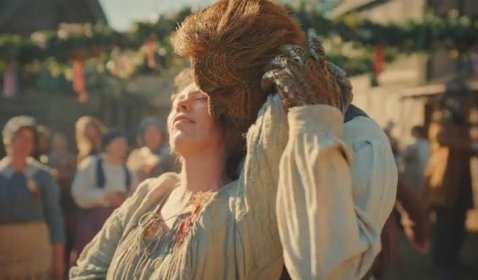
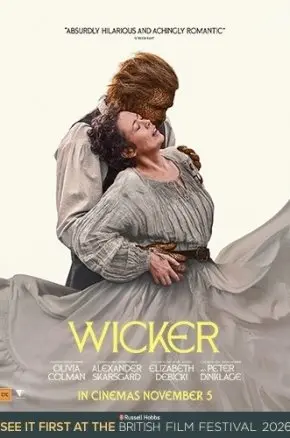
The result is the Wicker Husband, brought to life by Skarsgård. At first glance, he seems like the sort of creation that belongs in a nightmare. His body is woven from wicker, his movements are accompanied by creaking sounds, and his appearance is unlike anything the villagers would consider a suitable husband. Yet he proves to be attentive, patient and remarkably considerate. He helps around the house, treats his wife with respect and offers the affection she has been denied for most of her life.
It is a clever reversal of the traditional fairy tale. The woman dismissed by society finds happiness with someone society would consider even less acceptable. Her husband may not be human in the conventional sense, but he demonstrates a greater capacity for kindness than many of the people who judge him.
Colman is the film's emotional anchor. Few actors can make vulnerability feel so immediate without allowing it to become sentimental, and she brings that quality to the fisherwoman. There is a weariness in her performance that suggests years of humiliation have gradually shaped the way she sees herself. She has learned to expect cruelty, and even moments of kindness seem almost too good to trust.
What makes the performance particularly effective is the way Colman allows her character to retain her stubbornness. The fisherwoman is not simply a lonely woman waiting for someone to rescue her. She works, makes decisions and refuses to accept the village's judgment as the final word on her worth. Commissioning a husband from a basketmaker is an outrageous act, but it is also a declaration of independence. If the world will not make room for her, she will find another way to live.
Skarsgård provides an unexpectedly tender counterpoint. His Wicker Husband could easily have become a one-note joke, a handsome wooden creation whose sole purpose is to provoke laughter. Instead, the performance gives the character an understated sincerity. He is attentive without being possessive, affectionate without demanding anything in return, and confident enough to let his wife remain the centre of their relationship.
The humour comes partly from the contrast between his unusual appearance and his thoroughly considerate behaviour. Skarsgård understands the absurdity of the character without treating him as a punchline. His restraint is essential: the more seriously he approaches this impossible husband, the funnier and more moving the relationship becomes.
Together, Colman and Skarsgård create a romance that feels unexpectedly genuine. Their relationship is not built around grand declarations or conventional romantic gestures. Instead, it develops through everyday acts of care, mutual respect and the simple pleasure of being accepted. The film makes an appealing argument that love is less about fulfilling society's expectations than about finding someone who allows you to feel comfortable in your own life.
Dinklage adds another welcome dimension as the basketmaker. His performance carries a dry, almost mischievous quality, suggesting that he understands the absurdity of the world better than the people who live in it. He is not simply a magical craftsman providing a solution to the protagonist's problems. He represents an alternative way of seeing the world, one that leaves room for possibilities the villagers have already dismissed.
Elizabeth Debicki is equally effective as the Tailor's Wife, one of the fisherwoman's most determined tormentors. Elegant, calculating and deeply invested in social appearances, she initially seems to embody everything oppressive about the village. Yet her hostility also hints at a woman trapped by the same expectations she helps enforce. She may occupy a more privileged position than the fisherwoman, but that status comes with its own limitations.
This is where Wicker becomes more interesting than a straightforward revenge fantasy. The film does not suggest that every cruel person is secretly misunderstood, nor does it excuse the villagers' behaviour. Instead, it shows how rigid social systems encourage people to measure their worth against others. The fisherwoman's happiness becomes threatening because it exposes the possibility that the rules everyone follows are neither natural nor necessary.
Naturally, the arrival of the Wicker Husband does not go unnoticed. The couple's domestic happiness provokes jealousy, suspicion and outrage among the villagers. Men who have never considered whether they treat their wives well begin to feel threatened by a husband who does. Women who have built their identities around social status find themselves confronted by someone who has rejected the entire system and somehow become happier for it.
The resulting conflict provides the film with much of its dark comedy. Its jokes can be bawdy and deliberately uncomfortable, occasionally venturing into territory that will not appeal to every viewer. But the humour generally serves a purpose. By making the village's conventions look ridiculous, the filmmakers expose the absurdity of a society that values appearances and obedience more than affection.
The film's visual style reinforces that atmosphere. The setting resembles a storybook version of medieval Europe, but there is little of the polished romanticism often associated with period dramas. The village feels strange and restrictive, its customs carrying an unsettling mixture of folklore and social control. The production design creates a world that is beautiful enough to invite curiosity yet uncomfortable enough to make the protagonist's desire for escape understandable.
The cinematography also finds an effective balance between romance and unease. There is something slightly unnatural about the environment, as though the story is taking place in a fairy tale that has developed an unpleasant streak. That quality keeps the film hovering between genres. A tender domestic scene can be funny because of its unusual circumstances, then unsettling because of the world waiting outside the couple's home.
Despite its title and folklore-inspired premise, Wicker is not a conventional horror film. Those expecting sustained terror or a relentless supernatural mystery may be surprised by how much time it spends exploring marriage, jealousy and everyday intimacy. Its horror is primarily social: the cruelty of a community that punishes difference, the fear of losing one's place in society and the ease with which affection can become a source of suspicion.
That mixture is one of the film's greatest strengths, although it also creates some unevenness. The comedy occasionally threatens to overwhelm the more serious themes, while certain stretches of the story lean heavily on the novelty of the central relationship. The film is most effective when its unusual premise reveals something meaningful about its characters. When it relies too heavily on the joke itself, the emotional depth becomes less apparent.
The narrative also loses some momentum as the villagers' reactions begin to follow a predictable pattern. Their jealousy is understandable within the story's satirical framework, but the film occasionally repeats its point rather than developing it. A sharper final act might have brought the conflict to a more satisfying conclusion, giving the emotional and social tensions greater weight.
Nevertheless, the performances prevent these weaknesses from becoming fatal. Colman gives the fisherwoman enough inner life to make her happiness worth protecting, while Skarsgård makes the Wicker Husband far more than a novelty. Their chemistry gives the film its warmth, ensuring that the relationship remains believable even when everything surrounding it becomes increasingly absurd.
Ultimately, Wicker is a charmingly peculiar film that uses an outrageous romantic premise to examine some painfully familiar human behaviour. It is about a woman who refuses to accept that loneliness is the price she must pay for being different, and a society that becomes angry when she finds happiness outside its rules.
The film does not always balance its comedy, horror and romance perfectly, and its conclusion may leave some viewers wanting a more forceful payoff. But its central performances, inventive world and affectionate view of unconventional love make it difficult to dismiss.
There is something quietly radical about a fairy tale in which the supposedly monstrous figure turns out to be the kindest person in the village. Wicker understands that the real ugliness is often found elsewhere: in the people who insist that everyone must live, love and behave exactly as they do.
Rating: 4/5
Do you like it? Let's share it!


NOW SHOWING



COMING SOON