Wild Horse Nine — Secrets, Cynicism, and the Bitter Aftertaste of American Power
Martin McDonagh has built a reputation for making films in which dark humour and human misery exist side by side. His characters are often deeply unpleasant people who reveal their vulnerabilities through insults, arguments and uncomfortable confessions. With Wild Horse Nine, the filmmaker returns to familiar territory, pairing two morally compromised men in a story that mixes political intrigue, absurd comedy and the uneasy business of confronting one's past. The result is an entertaining, occasionally provocative character study, although it does not always reach the heights of his best work.
Set in 1973, the film follows Chris and Lee, two veteran CIA operatives stationed in Santiago, Chile, as the agency prepares for a covert operation against President Salvador Allende. Before events take their expected course, the increasingly unwell Chris heads to Easter Island, accompanied by Lee, his colleague and reluctant caretaker. Chris is struggling with a morphine habit and working on memoirs that threaten to expose secrets he was never supposed to reveal. What begins as an unusual detour gradually becomes a journey into the pair's shared history, political loyalties and deeply buried regrets.
John Malkovich plays Chris as a man whose sharp tongue and casual arrogance conceal a more complicated inner life. He is unpredictable, frequently offensive and often amusing, yet there is something quietly unsettling about watching a man who has spent his career serving powerful institutions begin to confront his own mortality. Malkovich understands the character's contradictions, delivering his dialogue with a peculiar rhythm that makes even the most outrageous remarks feel strangely plausible. His performance is one of the film's strongest assets, giving Chris a magnetic presence without making him particularly easy to like.
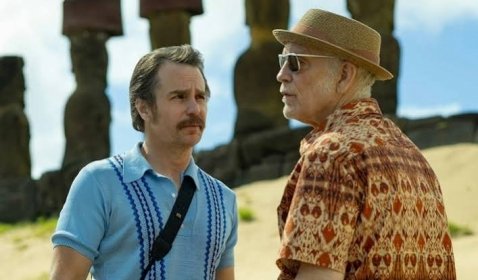
Sam Rockwell provides an effective counterbalance as Lee. Where Chris seems increasingly detached from the consequences of his actions, Lee is more restrained, caught between loyalty to his colleague and the uncomfortable reality of the life they have built together. Rockwell brings a restless energy to their exchanges, shifting between irritation, affection and weary resignation. Their chemistry is convincing precisely because their relationship never feels entirely healthy. They know each other's weaknesses too well, and their conversations suggest years of shared experiences that neither man is particularly eager to examine.
Much of the film's appeal lies in these interactions. McDonagh has a gift for writing dialogue that sounds spontaneous while gradually exposing the absurdity or cruelty beneath a character's worldview. The conversations in Wild Horse Nine can be hilarious, especially when the two agents find themselves out of their depth in an unfamiliar environment. Their exchanges are packed with sarcasm, petty arguments and startlingly blunt observations, creating the impression of two men who have perfected the art of conversation as a way to avoid confronting anything meaningful.
However, there are moments when the dialogue feels too pleased with itself. The characters frequently sound as though they are competing to deliver the most outrageous line, and some exchanges linger longer than their comic impact warrants. McDonagh's distinctive style remains recognisable, but familiarity occasionally works against him. The film sometimes resembles a variation on ideas he explored more successfully in In Bruges and The Banshees of Inisherin, with another uneasy male friendship placed under the pressure of guilt, violence and impending loss.
The political backdrop gives the story a more substantial dimension. By situating the film around the CIA's activities in Chile before the 1973 coup, McDonagh connects the personal failings of his characters to the machinery of American foreign intervention. Chris and Lee are not simply eccentric men with troubled pasts; they are participants in a system capable of causing immense harm while allowing those responsible to hide behind secrecy and institutional loyalty.
Yet Wild Horse Nine is more interested in the psychology of its operatives than in exploring the full historical consequences of their work. The political setting adds tension and moral complexity, but it rarely becomes the film's dominant concern. Viewers expecting a rigorous examination of Chilean history or the mechanics of covert intervention may find the treatment frustratingly selective. The film raises uncomfortable questions about power and responsibility without always following them to their logical conclusions.
Easter Island provides an intriguing setting for this moral reckoning. Its striking landscape and monumental stone figures create a sense of isolation that contrasts with the characters' restless, cynical personalities. Away from the familiar world of intelligence operations, the two men are forced to navigate an environment that does not particularly care about their professional reputations or political importance. The location gives the film a surreal quality, making their arguments feel increasingly detached from the ordinary concerns of the people around them.
Still, the film's tonal balance is not always successful. McDonagh moves between black comedy, violence and moments of genuine sentiment, but these elements occasionally clash rather than reinforce one another. A scene that initially invites laughter can suddenly turn disturbing, while attempts at emotional sincerity sometimes feel at odds with the characters' casual brutality. The contrast may be intentional, reflecting the way cruelty and affection coexist in damaged relationships, but it does not always produce the desired effect.
The screenplay also struggles to give every consequence the attention it deserves. As Chris and Lee confront the implications of their past, the film becomes increasingly interested in the possibility of regret and reconciliation. Yet its emotional resolution feels less convincing than the uncomfortable questions that precede it. The personal cost of Lee's choices, in particular, deserves more consideration, and the conclusion leaves certain aspects of the story feeling insufficiently resolved.
Even so, Wild Horse Nine remains worth watching for its central performances. Malkovich and Rockwell bring enough personality and tension to their scenes to sustain the film through its less effective passages. Their characters are unpleasant, contradictory and often ridiculous, but the actors make their companionship feel lived-in rather than manufactured. There is an underlying sadness to their banter, as though each joke is another attempt to delay a conversation neither man is prepared to have.
Ultimately, Wild Horse Nine is a film about men who have spent their lives rationalising their actions and are now discovering that cynicism cannot protect them from the past. Its sharpest moments emerge when the humour briefly gives way to something more troubling: the recognition that a person can be charming, intelligent and entertaining while remaining complicit in terrible things.
The problem is that the film's familiar storytelling and uneven tonal shifts prevent those ideas from landing with consistent force. It has the ingredients of a compelling political tragicomedy, and its leading actors deliver performances that are frequently engaging, but it never quite becomes the exceptional film its premise suggests.
Final Verdict: Wild Horse Nine is a darkly amusing and well-acted character study that benefits enormously from the chemistry between John Malkovich and Sam Rockwell. Its political undertones give the story substance, while its sharp dialogue provides plenty of memorable moments. However, uneven pacing, excessive cynicism and an occasionally unconvincing emotional payoff keep it from matching Martin McDonagh's finest work. It is a worthwhile watch, but not a modern classic.
Rating: 3/5 stars
Do you like it? Let's share it!
NOW SHOWING

COMING SOON