Buddy Review: A Cheerful Childhood Nightmare Wrapped in Blood and Absurdity
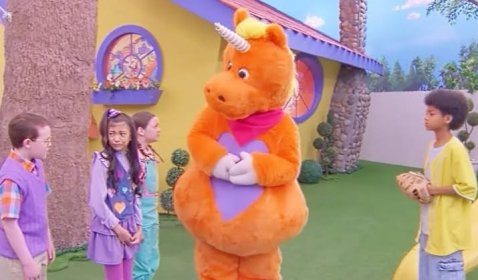
Children’s television is supposed to be a safe place, filled with cheerful songs, colorful characters, and lessons about friendship. But what happens when that familiar world becomes something sinister? In Buddy, director Casper Kelly takes the innocence of classic children’s programming and twists it into a bizarre horror-comedy that is as disturbing as it is darkly entertaining.
At the center of the film is Buddy, a bright orange unicorn who stars in a fictional children’s television show called It’s Buddy! Everything appears perfectly wholesome at first. The children sing, dance, and follow Buddy’s cheerful instructions, surrounded by colorful sets and friendly characters. But the illusion begins to crumble when one child refuses to participate. What follows reveals a much darker reality lurking beneath the show’s sugary surface.
The premise is immediately intriguing, particularly for anyone who grew up watching children’s programs filled with smiling mascots and relentlessly positive messages. Kelly understands that there is something inherently strange about entertainment that demands constant happiness. By exaggerating that artificial cheerfulness, he creates a world that feels unsettling long before the violence begins.
Keegan-Michael Key is perfectly cast as Buddy, bringing an unsettling combination of friendliness and menace to the character. His cheerful delivery makes Buddy particularly disturbing because even his most threatening moments retain the polished enthusiasm of a television host addressing a young audience. The contrast between his colorful appearance and increasingly disturbing behavior provides much of the film’s dark humor.
The young cast also deserves recognition. Delaney Quinn and her fellow performers bring convincing reactions to a situation that becomes progressively more horrifying. Their characters are trapped in a world where questioning authority can have terrifying consequences, and their growing suspicion gives the story much of its tension. Meanwhile, Cristin Milioti and Topher Grace add another dimension through the adult storyline, which gradually connects the strange events inside the television program to a more personal mystery.
Visually, Buddy makes excellent use of its deliberately artificial setting. The bright colors, vintage television aesthetic, and cheerful production design recreate the atmosphere of an old children’s program with impressive attention to detail. That carefully constructed innocence becomes the perfect backdrop for the film’s graphic violence. The contrast is often grotesque, but it is also the source of some of the movie’s most effective moments.
Kelly clearly has a talent for finding horror in familiar pop-culture imagery. Rather than relying entirely on conventional scares, he builds discomfort through repetition, awkward performances, and the increasingly obvious gap between Buddy’s public persona and his true nature. The result feels closer to a twisted nightmare about childhood entertainment than a traditional slasher film.
However, Buddy struggles to maintain its initial impact across the entire runtime. The central joke is effective, but the film returns to it so frequently that the novelty occasionally begins to wear thin. Just as the story appears ready to explore something more psychologically interesting, it often returns to another outrageous display of violence.
The film’s balance between horror and comedy can also be uneven. Some scenes are genuinely funny because of their sheer absurdity, while others seem to rely on shock value without adding much to the narrative. Although the underlying ideas about manipulation, conformity, and the unsettling nature of manufactured happiness are compelling, they could have been explored with greater depth.
That is ultimately the biggest disappointment. Buddy has the ingredients for something more substantial than a feature-length expansion of a disturbing television-show concept. Its strange atmosphere and memorable central character create plenty of possibilities, but the screenplay does not always develop those ideas beyond their immediate comedic or shocking effect.
Nevertheless, the film remains an unusual piece of horror filmmaking. Its willingness to embrace absurdity gives it a distinctive identity, and there is something undeniably entertaining about watching such an aggressively cheerful character become the source of absolute terror. It may not be consistently frightening, but it certainly understands how to make an innocent image feel deeply wrong.
Verdict
Buddy is a wonderfully twisted horror-comedy that transforms the familiar conventions of children’s television into a colorful nightmare. Casper Kelly demonstrates a sharp visual imagination, while Keegan-Michael Key delivers a memorable performance that makes the titular character both ridiculous and genuinely unsettling.
The problem is that the film’s central idea occasionally feels stretched beyond its natural limits. Its dark humor and graphic violence provide plenty of memorable moments, but the storytelling lacks the consistency needed to turn a clever premise into a truly exceptional film.
Even so, viewers looking for unconventional horror with a healthy dose of absurdity will find plenty to appreciate. Buddy may not have as much beneath its colorful exterior as it initially suggests, but its strange energy makes it difficult to dismiss entirely.
Rating: 3.5/5
Do you like it? Let's share it!




NOW SHOWING



COMING SOON