Coyote vs. Acme — The Coyote Finally Fights Back
For decades, Wile E. Coyote has been one of animation's great losers. He has fallen off cliffs, been flattened by rocks, blown himself up and survived countless schemes that should have ended his pursuit of the Road Runner a very long time ago. His genius, as the joke goes, has always been questionable.
Coyote vs. Acme finally asks a surprisingly reasonable question: what if the Coyote simply sued the company responsible for all those disasters?
It is an absurd premise, but that is precisely why it works.
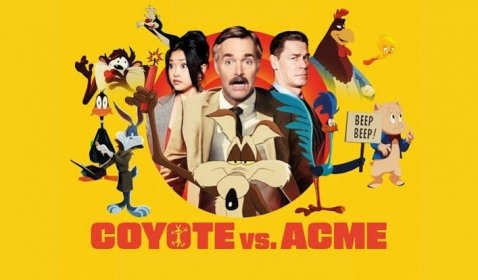
Directed by Dave Green, Coyote vs. Acme combines live-action comedy with 2D animation, placing Wile E. Coyote in a story that expands far beyond the familiar desert chase. After yet another Acme product fails spectacularly, the long-suffering Coyote decides that enough is enough and takes the corporation to court.
He gets help from Kevin Avery, a struggling billboard lawyer played by Will Forte, while John Cena steps in as Buddy Crane, the slick attorney representing Acme.
On paper, it sounds like a gimmick.
Surprisingly, the movie finds more life in the idea than expected.
The smartest thing the screenplay does is treat Wile E. Coyote not simply as a cartoon character but as someone who has genuinely been wronged. For generations, audiences have watched him purchase Acme products that repeatedly fail at the worst possible moment. Here, the film turns that running gag into the basis for an actual legal argument.
It is silly, but there is something satisfying about seeing the Coyote finally ask for compensation.
Will Forte is a good fit for the film's particular brand of absurdity. Kevin is hardly a brilliant courtroom strategist, but Forte gives him enough personality to prevent him from becoming just another generic human character surrounded by cartoons. His frustration with his own professional failures also gives the story a second emotional thread.
The movie works best when Forte is allowed to play things relatively straight.
That contrast is important because the Looney Tunes characters are, naturally, operating according to completely different rules.
Wile E. Coyote can survive explosions that would kill an ordinary human being. Acme technology appears to function according to cartoon physics. Road Runner remains almost impossibly elusive. Putting these characters into a world where lawyers, corporations and legal contracts matter creates a strange collision between reality and cartoon logic.
The film doesn't always make that collision work.
Some of the live-action comedy feels broader than it needs to be, and the screenplay occasionally stretches a joke well beyond its natural lifespan. At just over 100 minutes, Coyote vs. Acme is not particularly long, but there are stretches where the story feels like it is running in circles.
Ironically, the film sometimes suffers from the same problem as its title character.
It knows where it wants to go, but keeps taking unnecessary detours to get there.
John Cena, however, seems to understand exactly what kind of movie he is in. As Acme's attorney, he brings a wonderfully exaggerated confidence to the role. Cena has become increasingly comfortable with comedy, and his performance here benefits from that experience. He plays Buddy as someone who genuinely believes he is the smartest person in every room, which makes his clashes with Forte more entertaining than they have any right to be.
The animated sequences are another highlight.
Rather than trying to completely modernize the Looney Tunes aesthetic, the film allows the characters to retain much of their classic visual identity. That is important. Wile E. Coyote works because he looks and moves like Wile E. Coyote. Turning him into a hyper-realistic CGI creature would have destroyed much of the joke.
The film also understands that the character's failures are more entertaining than his successes.
There is a certain sadness to Wile E. Coyote's endless obsession with catching the Road Runner. He is intelligent enough to design elaborate schemes, wealthy enough to order increasingly ridiculous products and determined enough to keep trying after every catastrophic failure.
He simply cannot let go.
That makes the movie's underlying story unexpectedly relatable.
The courtroom material gives the Coyote something he has rarely had in the cartoons: a chance to explain himself. His relationship with Acme becomes a playful satire of corporate responsibility, consumer frustration and the idea that powerful companies can simply keep selling products that don't work.
The satire isn't especially sharp, but it is amusing.
The film never becomes a genuinely biting corporate comedy, which is probably for the best. A darker version of Coyote vs. Acme could have easily become too cynical for its family-friendly tone. Instead, the movie keeps things light, using its corporate villainy mostly as another excuse for jokes.
That does leave the film feeling somewhat safer than its premise suggests.
There was an opportunity here to make something genuinely subversive—a Looney Tunes movie about corporate greed, intellectual property and the absurdity of consumer lawsuits. Instead, the filmmakers mostly use those ideas as the framework for a conventional family comedy.
It is entertaining, but rarely surprising.
The emotional side of the story is similarly straightforward. Kevin has his own professional and personal problems, and his involvement with Wile E. gives him a reason to believe in something again. It is familiar territory, but Forte gives the material enough warmth to keep it from becoming unbearable.
And perhaps that is the best way to describe Coyote vs. Acme: familiar, but charming.
The film does not reinvent the Looney Tunes. It does not deliver a revolutionary take on Wile E. Coyote. It simply takes a joke that has existed for decades and asks what would happen if the joke became a lawsuit.
Sometimes, that is enough.
There are certainly moments when the movie feels longer than a classic Looney Tunes short should ever be. The original cartoons were built around quick setups and explosive payoffs. Here, every joke has to survive a feature-length story, and not all of them do.
But when the film gets the balance right—when live-action characters react seriously to completely ridiculous animated behaviour—it can be genuinely funny.
More importantly, it respects the characters.
That matters.
After so many attempts to reinvent classic animation properties for modern audiences, Coyote vs. Acme is refreshingly content to let Wile E. Coyote remain Wile E. Coyote. He is still stubborn. He is still unlucky. He is still convinced that the next plan will work.
Only now, he has a lawyer.
The result is not a flawless comedy, but it is a surprisingly affectionate one. There are jokes that miss, stretches that drag and a story that never quite reaches the cleverness of its central premise. Yet the movie has enough heart and enough Looney Tunes energy to make the experience worthwhile.
Coyote vs. Acme ultimately understands something important about Wile E. Coyote: his greatest quality has never been his intelligence.
It is his refusal to give up.
Even after everything goes wrong, he gets back up, dusts himself off and tries again.
For once, maybe the Coyote deserves a win.
Rating: ★★★½☆ (3.5/5)
Do you like it? Let's share it!


NOW SHOWING



COMING SOON