
Drummer Boy Review: A Stirring Battle for Freedom That Struggles to Find Its Rhythm
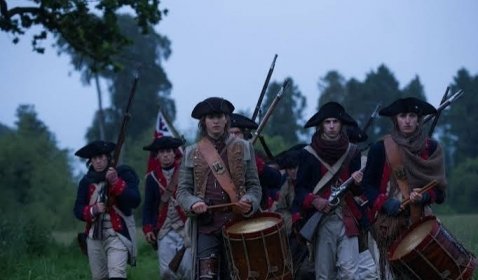
Set against the turmoil of the American Revolutionary War, Drummer Boy attempts to combine historical drama, romance, faith and musical storytelling into one emotionally charged experience. Directed by brothers Ben Smallbone and Joel Smallbone, the film explores the complicated relationship between freedom, family loyalty and forgiveness. It has a compelling foundation, but its uneven musical numbers and familiar dramatic choices prevent it from reaching its full potential.
The story follows brothers Jeremiah Clem (Joel David Smallbone) and Benjamin Clem (Lucas Leach), whose lives take sharply different directions as the conflict between Britain and the American colonies intensifies. Jeremiah joins the British Army in an effort to protect his family, while Benjamin sides with the Patriots, determined to prove himself despite his physical limitations. Their opposing loyalties turn an already difficult family situation into a deeply personal struggle.
One of the film's greatest strengths is the way it connects the larger political conflict to the brothers' individual experiences. Neither character is presented as entirely free from doubt or personal ambition. Jeremiah's decisions are shaped by responsibility and fear of losing what remains of his family, while Benjamin's determination comes from a desire to demonstrate that he is capable of more than others believe. Their disagreement gives the historical setting an emotional dimension that goes beyond the familiar spectacle of war.
Joel David Smallbone delivers a committed performance as Jeremiah, portraying a man whose sense of duty gradually becomes a source of internal conflict. Lucas Leach provides a convincing counterpoint as Benjamin, bringing vulnerability and determination to a character fighting to earn respect. Their contrasting personalities help sustain the drama, particularly when the story focuses on the consequences of their choices rather than the broader demands of its historical setting.
India Brown also makes a strong impression as Emmaline, an enslaved young woman whose search for freedom introduces another important perspective into the narrative. Her connection with Jeremiah adds emotional complexity, especially as the film explores the contradiction between fighting for liberty and accepting the continued oppression of others. Brown brings warmth and dignity to the role, although the screenplay could have devoted more time to developing her experiences beyond their impact on the male characters.
The film's visual presentation is another notable strength. The period costumes, production design and countryside cinematography create a convincing sense of the eighteenth-century setting. The battle sequences add urgency without overwhelming the more intimate family drama. These elements give Drummer Boy a solid cinematic foundation, even when its narrative occasionally becomes too predictable.
The musical component, however, is where the film becomes more inconsistent. Incorporating songs into a Revolutionary War drama is an ambitious choice, and some performances successfully heighten the characters' emotions. Others feel too similar in their delivery and tone, making it difficult for individual numbers to leave a lasting impression. The soundtrack occasionally reinforces emotions that the dialogue has already communicated, rather than revealing something new about the characters.
This repetition weakens the film's momentum. With several relationships and competing storylines demanding attention, the musical sequences sometimes interrupt the dramatic progression instead of strengthening it. The result is a film that appears more confident when concentrating on the brothers' conflict than when attempting to balance every element of its musical ambitions.
The romantic subplot also struggles to find enough room to develop naturally. Although it introduces some of the story's more meaningful questions about identity, injustice and recognition, its emotional possibilities are not explored as thoroughly as they could be. Certain developments feel designed to produce a reaction rather than emerging organically from the characters' decisions.
Nevertheless, Drummer Boy has a clear emotional purpose. Its themes of sacrifice, perseverance and reconciliation give the story a sense of direction, while its examination of slavery complicates the idealistic language of freedom surrounding the Revolution. The film does not always explore these ideas with sufficient nuance, but they provide a stronger foundation than the more predictable aspects of its storytelling.
Ultimately, Drummer Boy is a sincere historical musical with worthwhile ideas and several effective performances. Its strongest moments come from the fractured relationship between its central brothers and the difficult choices that separate them. The impressive visuals and occasional musical highlights help carry the experience, even as repetitive songs and underdeveloped subplots limit its impact.
For viewers who appreciate faith-centred historical dramas, the film may offer an emotionally satisfying experience. Those expecting a consistently powerful musical or a particularly nuanced examination of the Revolutionary War may find it less rewarding. Drummer Boy has heart, but it never quite brings all its elements into harmony.
Rating: 3/5
Do you like it? Let's share it!



NOW SHOWING






COMING SOON