Fall 2: Deadpoint — Higher, Wilder, and Somehow Less Frightening
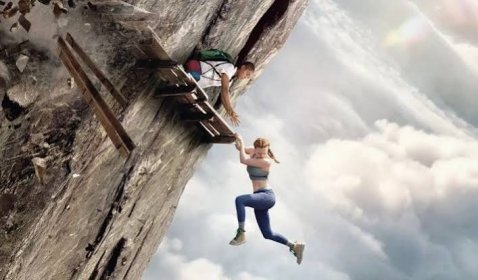
There is something wonderfully simple about the premise of Fall. Two people climb a ridiculously tall tower, something goes horribly wrong, and suddenly the safest option is to stay exactly where they are—even though "where they are" happens to be hundreds of feet above the ground.
The 2022 film understood that simplicity. It didn't need an elaborate mythology or a complicated villain. It simply put its characters in an impossible situation and allowed the audience's fear of heights to do most of the work.
Fall 2: Deadpoint attempts to take that same formula to a bigger and more spectacular location. Unfortunately, the sequel seems to have forgotten one important lesson from its predecessor: sometimes less really is more.
This time, the story follows Jax, the sister of Shiloh from the original film, and Luce, Shiloh's adventurous friend. Still dealing with the aftermath of Shiloh's death, the two travel to Thailand to complete one of the late climber's unfinished adventures. Their destination is Mount Kwan, where an absurdly dangerous plank walk high above the ground quickly turns into exactly the kind of disaster anyone with common sense would have predicted.
Harriet Slater and Arsema Thomas make a convincing pair. Their characters are not particularly complicated, but both actresses sell the fear of being trapped in an environment where one wrong movement could mean instant death. Slater gives Jax an understandable vulnerability, while Thomas brings more confidence to Luce's determination.
Their performances are important because the screenplay doesn't always give them much to work with.
The dialogue frequently falls into generic motivational territory. Characters talk about conquering fear, overcoming grief and believing in themselves, but the conversations rarely feel like things real people would say while hanging thousands of feet above the ground. Instead of deepening the relationship between Jax and Luce, the dialogue occasionally makes the film feel like an inspirational poster that happens to be covered in sweat and blood.
Fortunately, the actual climbing sequences are considerably better.
When Deadpoint puts its characters in danger, the movie can still make your palms sweat. The unstable planks, rusted metal and enormous drops are effective reminders of just how little separates the characters from a fatal fall. The camera knows exactly where to look, and the filmmakers make good use of vertiginous angles that turn even a simple step into a potential catastrophe.
These are the moments when the film works.
You may find yourself gripping the armrest as a plank cracks or a character attempts to move across an impossibly narrow ledge. The physical anxiety is genuine, even when the story surrounding it is considerably less convincing.
The problem is that Fall 2: Deadpoint doesn't know when to stop.
The original film had a wonderfully focused concept. The sequel adds more characters, more backstory, more twists and considerably more explanation. Instead of making the experience richer, these additions often dilute the central fear. The more the film tries to construct a complicated story around the climbing, the less convincing that story becomes.
One particular twist changes the way we understand the characters and their situation. In theory, it is exactly the kind of revelation a sequel needs. In practice, however, it requires the audience to accept a number of increasingly questionable decisions. Once you start thinking about the logic behind it, the whole thing begins to wobble.
And that is a recurring problem with Deadpoint: thinking too much about it is dangerous.
The characters repeatedly make decisions that seem designed to move the screenplay forward rather than protect their own lives. You may find yourself asking why anyone would willingly put themselves in this situation in the first place. The movie provides explanations, but they rarely feel persuasive enough.
This is particularly frustrating because the central concept is already effective. There is no need to manufacture elaborate reasons for people to climb into danger. The danger itself is enough.
Visually, however, the film is impressive. The Thai setting gives the sequel a different atmosphere from the first movie, while the enormous scale of the environment provides plenty of opportunities for breathtaking shots. Some sequences are genuinely beautiful before the movie inevitably reminds us that these characters are about to fall off something.
The directors, Michael and Peter Spierig, also maintain a reasonably brisk pace once the main survival scenario begins. The film does not spend its entire runtime staring at the characters while they panic. There are enough changes in circumstance to keep the situation evolving, even if some of those developments become increasingly ridiculous.
And yes, the film gets ridiculous.
The first Fall already had its share of B-movie logic, but Deadpoint pushes that quality much further. The twists become increasingly outrageous, and the final stretch abandons much of the grounded tension in favor of spectacle and surprise. The result is occasionally entertaining in exactly the way a ridiculous thriller can be entertaining—but it is difficult to take the story seriously.
That's the strange balance of Fall 2: Deadpoint. It can make you genuinely anxious one minute and roll your eyes the next.
The sequel also has the unfortunate problem of following a movie that did this better. Fall took a simple idea and stretched it into an unexpectedly effective survival thriller. Deadpoint tries to make that formula bigger, but bigger doesn't necessarily mean scarier. The Guardian similarly argues that the sequel struggles to reach the heights of its predecessor, despite providing enough hand-over-mouth moments for genre fans.
Still, there is enough here to make the film worthwhile for viewers who simply want a physical thrill ride.
If you are afraid of heights, some of these sequences will probably work regardless of how silly the screenplay becomes. The filmmakers understand that the sight of someone standing on a tiny plank with nothing but empty air beneath them remains an incredibly effective cinematic weapon.
But once the film starts asking you to care about its increasingly complicated mythology, the cracks begin to show.
Fall 2: Deadpoint is therefore an uneven sequel. It has solid performances, impressive locations and several sequences capable of inducing genuine anxiety. Unfortunately, it also has implausible motivations, predictable emotional beats and a screenplay that repeatedly overcomplicates a premise that worked best when it was simple.
It isn't a complete failure. There are moments when the film succeeds brilliantly at making you afraid to look down.
The problem is that, between those moments, there is simply too much to look at.
Rating: ★★½☆☆ (2.5/5)
Do you like it? Let's share it!

NOW SHOWING





COMING SOON