
Hadestown: The Musical — A Soulful Descent into Love, Loss, and the Power of Hope
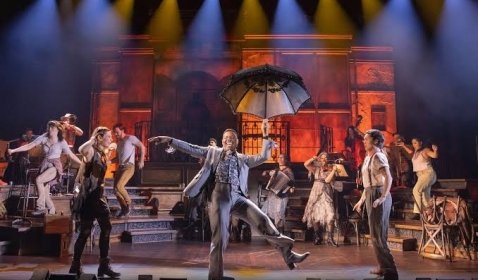
Some tragedies are painful because we do not know how they will end. Others hurt precisely because we do. Hadestown: The Musical belongs firmly in the second category. It takes the ancient Greek myth of Orpheus and Eurydice, gives it the smoky atmosphere of Depression-era America, and turns a familiar story into an emotionally rich musical about love, poverty, power and the stubborn human need to believe in a better ending.
Filmed live at London's Lyric Theatre, this production brings Anaïs Mitchell's celebrated musical to the cinema without stripping away its theatrical identity. The result feels less like a conventional movie musical and more like being invited into a strange, intimate world where the music carries as much weight as the dialogue.
The story follows Orpheus, a gifted but penniless musician, and Eurydice, a young woman who has learned that surviving the world often requires more than optimism. Orpheus believes he can write a song powerful enough to restore spring to a troubled world. Eurydice, meanwhile, is less convinced that love can provide food, shelter or security.
When hardship drives her toward Hadestown, the industrial kingdom ruled by Hades, Orpheus sets out to bring her back. His journey becomes a test of trust, with the fate of their relationship resting on a single condition: he must walk ahead of Eurydice without looking back until they reach the world above.
It is a simple premise, but Mitchell finds plenty of complexity within it. The story is not only about whether Orpheus can trust Eurydice. It is also about whether love can survive economic desperation, whether security is worth the loss of freedom, and how fear can gradually destroy the very things people are trying to protect.
The musical's greatest achievement is the way it makes these ideas feel natural rather than academic. Hadestown is a factory floor where workers surrender their individuality in exchange for stability. Hades offers protection, but that protection comes at a cost. His kingdom promises a future free from uncertainty, provided its inhabitants accept the rules and stop asking what they have sacrificed.
The parallels with the modern world are difficult to miss, yet the production never loses sight of its characters. Its social commentary emerges through the atmosphere of the underworld and the decisions people make when they have few good options left.
The music is what gives the story its extraordinary force.
Mitchell's score draws on American folk, blues and New Orleans jazz, creating a sound that feels earthy and timeless. The songs have the warmth of old stories passed down through generations, but there is also a restless energy beneath them. The rhythms can be playful one moment and deeply melancholy the next, allowing the production to move between romance, humour and tragedy without losing its identity.
The recurring musical motifs are particularly effective. They give the story a sense of inevitability, as though the characters are moving along tracks that have been laid long before they arrived. Even when the music becomes joyful, there is often a shadow of sadness waiting underneath.
Patrick Page is outstanding as Hades. His deep, resonant voice gives the character an imposing presence, but the performance is more interesting than a simple portrayal of a villain. Page presents Hades as a man who believes his own justifications. His desire for control grows from insecurity and fear, making him more unsettling than a ruler who is evil merely for the sake of it.
Amber Gray brings a welcome unpredictability to Persephone. She is warm, funny and occasionally unruly, but her liveliness also suggests someone who has grown tired of living within the boundaries of another person's ambitions. Her chemistry with Page gives their relationship a complicated texture, revealing a marriage in which affection and resentment have become difficult to separate.
André De Shields is equally compelling as Hermes, the narrator who guides the audience through the story. His presence brings a sense of history and familiarity to the production, as if he has told this tale countless times and understands that knowing the ending does not make it any less worth telling. He is charismatic without dominating the other performers, providing the story with a steady and reassuring voice.
Reeve Carney and Eva Noblezada give Orpheus and Eurydice an appealing contrast. Carney plays Orpheus with a gentle idealism that can be beautiful and frustrating in equal measure. Noblezada's Eurydice is more guarded, shaped by a life in which hope has rarely been enough to keep hardship at bay. Their differences make the romance believable, even when the relationship itself occasionally receives less attention than the production's broader themes.
The stage design deserves just as much praise as the cast. The industrial machinery, shadowy lighting and steampunk-inspired costumes give Hadestown a distinctive visual identity. The choreography often makes the ensemble resemble parts of a single machine, reinforcing the idea that the underworld is a place where individual lives are absorbed into a larger system.
Brett Sullivan's camera work helps translate that design to the screen. Close-ups capture subtle changes in the actors' expressions, while wider shots preserve the scale of the stage and the movement of the ensemble. There is a genuine sense of being inside the performance rather than watching it from a detached distance.
Of course, a filmed stage production cannot completely recreate the experience of live theatre. The camera occasionally interrupts the natural flow of a scene, and some musical numbers linger longer than necessary. At times, the atmosphere takes precedence over narrative momentum, making certain stretches feel more extended than they need to be.
These are relatively minor weaknesses, however, because the production understands what makes the musical special. It does not rely on elaborate cinematic tricks or attempt to turn every song into a spectacle. Its strength lies in the performers, the musicians and the gradual accumulation of emotion.
And then there is the ending.
Without giving too much away, Hadestown understands that a tragedy does not have to offer a happy resolution to leave its audience with hope. Its power comes from the decision to keep believing in a story even when its outcome seems inevitable. The characters may be trapped by their own weaknesses, but the act of telling their story again becomes a small gesture of resistance against despair.
That idea gives the musical a resonance that extends beyond Greek mythology. It speaks to anyone who has loved someone, doubted themselves or continued hoping despite having every reason to stop.
Not every song lands with equal force, and the central romance can occasionally feel overshadowed by the production's more compelling political and philosophical ideas. Yet the music, performances and visual atmosphere create an experience that remains emotionally rewarding even when the narrative slows down.
Hadestown: The Musical is a rare filmed theatre production that feels both intimate and expansive. It understands that the oldest stories can still speak to contemporary audiences, not because their circumstances remain unchanged, but because their fears and desires are recognisably human.
By the time the final notes fade, the film leaves behind a feeling that is difficult to shake: sadness for what has been lost, admiration for those who dared to hope, and a quiet willingness to hear the story one more time.
Rating: 4.5/5
Do you like it? Let's share it!




NOW SHOWING




COMING SOON