Klara and the Sun: A Touching Sci-Fi Tale About Love, Loss and the Heart of Being Human
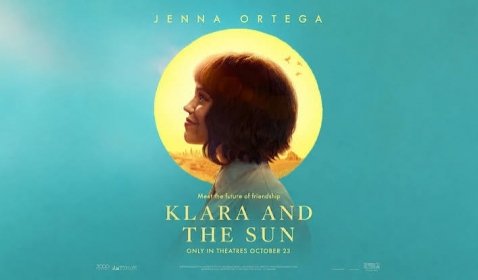
Taika Waititi’s latest film brings Kazuo Ishiguro’s acclaimed novel to Australian cinemas, with Jenna Ortega leading a moving story about artificial intelligence, loneliness and the connections that make life meaningful.
A robot designed to ease loneliness may sound like the answer to a very modern problem, but Klara and the Sun asks a more difficult question: can technology ever truly understand what it means to love someone?
Arriving in Australian cinemas on 22 October 2026, the science-fiction drama adapts the bestselling novel by Nobel Prize-winning author Kazuo Ishiguro. Directed and co-written by Taika Waititi, the filmmaker behind Jojo Rabbit and Hunt for the Wilderpeople, the film combines a futuristic setting with an intimate story about family, grief and the fragile nature of human connection.
Jenna Ortega stars as Klara, an Artificial Friend, or AF, created to provide companionship to people who need it. Observant, curious and unusually hopeful, Klara spends her early days waiting for someone to choose her. Her life changes when she meets Josie, a bright teenager played by Mia Tharia, who takes Klara home to become her companion.
At first, the arrangement appears straightforward. Klara is there to keep Josie company, offering the attention and loyalty that a machine can be programmed to provide. But the relationship becomes more complicated as Klara begins to understand the emotional difficulties surrounding the family. Josie has a strained relationship with her mother, Chrissie, played by Amy Adams, and the household is still carrying the weight of past losses.
As Klara grows closer to Josie, she becomes determined to help her friend and the people she loves. Her belief in the sun as a source of life and healing shapes the way she interprets the world, giving the story a distinctive perspective on hope. While the humans around her struggle with uncertainty, Klara approaches their problems with an almost unwavering faith that something can be done.
The film's emotional centre lies in the contrast between Klara's artificial origins and her capacity for compassion. Designed to serve a purpose, she gradually becomes more than a product intended to meet a customer's needs. Her devotion raises questions about whether empathy must come from human experience, or whether the willingness to care for another person might be meaningful in its own right.
That question becomes particularly poignant against the film's dystopian backdrop. In a society shaped by technological progress and genetic enhancement, the advantages enjoyed by some young people have created divisions that extend into everyday life. Josie's circumstances reveal the personal cost of a world that places considerable value on ability, achievement and the promise of a better future.
Rather than relying solely on futuristic spectacle, Klara and the Sun uses its science-fiction premise to examine concerns that already feel familiar. As artificial intelligence becomes increasingly present in everyday life, the distinction between convenience and genuine connection has become harder to ignore. Waititi's adaptation brings that tension into a story where the most advanced technology cannot necessarily resolve the deepest emotional problems.
Ortega takes on a different kind of role from the darker characters that have helped establish her screen identity. As Klara, she must communicate a sense of innocence and wonder while portraying a being whose understanding of human behaviour is still developing. The performance asks her to approach ordinary interactions with a mixture of curiosity, sincerity and quiet determination.
Adams brings additional weight to the role of Chrissie, a mother attempting to navigate her daughter's complicated circumstances while confronting her own fears. Tharia's Josie sits between them, caught in the tension between her desire for independence and the vulnerability created by her illness. Together, the three performances form the core of a story that is less concerned with technological breakthroughs than with the difficult choices families make when faced with uncertainty.
The supporting cast includes Aran Murphy as Rick, alongside Natasha Lyonne, Steve Buscemi and Rachel House. Their presence adds further interest to a film built around an ensemble of characters whose lives intersect through questions of care, responsibility and belonging.
For Waititi, the project represents a return to science fiction through a more emotionally focused lens. His previous films have often combined humour with subjects that carry a darker undertone. Klara and the Sun offers another opportunity to explore that contrast, bringing his distinctive sensibility to Ishiguro's contemplative source material.
The adaptation also faces a considerable challenge. Ishiguro's novel derives much of its power from its restrained perspective and its unanswered questions about consciousness, loyalty and the human desire to be loved. Translating those subtleties to the screen requires more than an affecting performance or a striking futuristic setting. The film must preserve the uncertainty at the heart of the story without turning its themes into simple lessons.
That balance will be central to the film's appeal. Viewers looking for an action-heavy science-fiction adventure may find its family drama and philosophical concerns more prominent than its technological spectacle. Those drawn to character-driven stories, however, may appreciate the opportunity to consider familiar questions from the perspective of someone who is not quite human.
At 116 minutes, Klara and the Sun has room to explore the relationships that shape its central character while building a portrait of a society wrestling with the consequences of its own progress. Its strongest appeal lies in the contrast between its futuristic world and its timeless concerns: the fear of losing someone, the need to feel understood and the hope that kindness can make a difference even when the outcome remains uncertain.
With Ortega at the centre and Waititi bringing Ishiguro's novel to the screen, Klara and the Sun is shaping up as a thoughtful alternative to the more conventional blockbusters arriving this season. Its premise may involve artificial intelligence, but its most important questions are unmistakably human.
Australian audiences can see Klara and the Sun in cinemas from Thursday, 22 October 2026. The film runs for 116 minutes and carries an Australian M classification for mature themes and coarse language. Session times and ticket availability can be checked through HOYTS Cinemas and Event Cinemas.
Do you like it? Let's share it!



NOW SHOWING






COMING SOON