
Whalefall — Swallowed by the Deep, Haunted by the Past
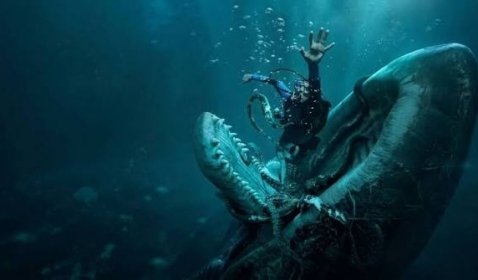
Some survival thrillers trap their characters in burning buildings, freezing wildernesses, or isolated stretches of ocean. Whalefall takes the concept somewhere considerably more disturbing: inside the body of a giant sperm whale. It is an outrageous premise, almost impossible to imagine working as a feature film, yet director Brian Duffield approaches it with enough visual imagination to make the situation genuinely unsettling. Unfortunately, while the film delivers moments of extraordinary physical horror, its attempts to give that nightmare an emotional centre are less consistently successful.
Based on Daniel Kraus's novel, Whalefall follows Jay Gardiner (Austin Abrams), a young diver who ventures into the waters off the California coast in search of his deceased father's remains. His father, Mitt (Josh Brolin), was an experienced diver whose difficult relationship with Jay left behind years of resentment and unresolved pain. The search takes a terrifying turn when Jay is swallowed by a massive sperm whale, leaving him with roughly an hour of oxygen to find a way out.
The premise immediately establishes the film's greatest strength: its ability to make an impossible situation feel physically horrifying. Jay is not simply lost at sea. He is trapped inside a living creature, surrounded by unfamiliar tissue, slippery surfaces, and potentially lethal digestive fluids. Every movement becomes a risk, and every decision costs precious time. The ocean is already an intimidating environment, but the whale's interior transforms it into something almost alien.
Duffield, who previously directed No One Will Save You, clearly understands how much unease can be extracted from confined spaces. The whale's body is rendered as a grotesque labyrinth, a place where the distinction between a possible escape route and a fatal mistake is difficult to recognise. The film's sound design adds to the discomfort, emphasising Jay's strained breathing and the strange, muffled noises of his surroundings. The result is an experience that can feel suffocating even when the screen opens onto the vastness of the Pacific.
Some of the imagery is genuinely difficult to shake. The film does not shy away from the physical consequences of Jay's predicament, using injuries, digestive fluids, and the whale's powerful internal movements to make his struggle feel punishing. These sequences are unpleasant by design, but they are also among the film's most effective. Rather than relying entirely on conventional jump scares, Whalefall makes the human body itself a source of vulnerability. Survival is no longer an abstract goal; it becomes a desperate effort to keep breathing while everything around you seems designed to destroy you.
The contrast between the ocean's immense beauty and the grotesque environment inside the whale is equally striking. Cinematographer Aaron Morton gives the underwater sequences a cold, unsettling realism. The sea appears beautiful from a distance, but its darkness quickly becomes oppressive once Jay descends beneath the surface. Light disappears, visibility narrows, and the water begins to feel less like a landscape than an enormous void.
These visual qualities help compensate for the story's increasingly implausible turns. The central situation requires a considerable suspension of disbelief, and the film occasionally pushes that indulgence too far. Yet the problem is not simply that the premise is unrealistic. Creature features can thrive on absurdity when they establish their own rules and maintain a consistent sense of danger. Here, the mechanics of Jay's escape sometimes become so elaborate that the suspense gives way to disbelief. The more the film asks us to accept, the harder it becomes to remain completely absorbed in the ordeal.
Still, Abrams makes a convincing guide through this bizarre nightmare. Jay is not a conventional action hero, and Abrams wisely avoids turning him into one. He plays the character as vulnerable, frightened, and physically overwhelmed, someone whose intelligence is frequently challenged by the sheer impossibility of his situation. His performance gives the film an important human presence, particularly during moments when Jay must make decisions with no guarantee that any of them will work.
Because so much of the story takes place inside the whale, Abrams carries an unusually heavy burden. He must communicate panic, pain, exhaustion, and flashes of determination while interacting with little more than his surroundings. It is a demanding performance, and he brings enough nervous energy and emotional fragility to keep Jay engaging even when the screenplay struggles to make his predicament feel entirely credible.
The film's other major element is its relationship drama. Jay's desperate fight for survival repeatedly brings back memories of Mitt, a father whose knowledge of the ocean was matched by his capacity for cruelty. Through flashbacks, we learn more about their strained relationship and the expectations Mitt placed on his son. His lessons about diving, whale anatomy, and survival now become potential tools for Jay's escape, forcing the younger man to confront the complicated legacy of someone he both resented and wanted to understand.
It is a promising emotional framework. The idea that knowledge passed down through an abusive parent might save the child who suffered under that parent's authority gives the survival story a meaningful psychological dimension. Jay cannot simply reject everything Mitt taught him, even if he wants to reject the man himself. His predicament becomes a struggle not only against the whale but also against the memories that continue to shape him.
Brolin brings an imposing presence to Mitt, portraying him as a man whose expertise and authority conceal deep emotional damage. He can be charismatic when discussing the sea, but his relationship with Jay reveals a harsher side: a man who mistakes intimidation for strength and treats vulnerability as a personal failure. Brolin gives the character enough force to make the flashbacks compelling, although Mitt sometimes comes across as a familiar cinematic version of the domineering father rather than a fully surprising human being.
The difficulty is that these flashbacks interrupt the survival story more often than they deepen it. Just as Jay's situation becomes especially tense, the film pulls away to revisit another painful memory. Some of these scenes help explain his emotional isolation, but others repeat information that is already clear. Mitt's cruelty is established early, and the film occasionally labours to reinforce it rather than allowing the audience to draw its own conclusions.
This structure also weakens the sense of urgency. Jay has limited oxygen and faces a series of immediate physical dangers, yet the film repeatedly asks viewers to shift from visceral suspense to reflective family drama. The two strands should complement each other, with each new obstacle revealing something about Jay's past or changing his understanding of his father. Too often, however, they feel like competing narratives rather than parts of the same story.
The supporting characters, including Jay's mother Zara (Elisabeth Shue) and his sisters Eva (Jane Levy) and Nan (Emily Rudd), provide some context for the family dynamic, but they receive comparatively limited space to develop. The emotional focus remains firmly on Jay and Mitt, leaving the wider consequences of their relationship less explored than they might have been.
There is also a tonal question that the film never entirely resolves. At its best, Whalefall is an intense survival thriller with touches of body horror and an almost dreamlike visual imagination. At other times, it reaches for sentiment in ways that feel too familiar. The film wants to make its extraordinary premise serve as a metaphor for grief, inherited trauma, and the possibility of finding something useful in a damaged relationship. Those themes are worthwhile, but the more explicitly the story explains them, the less powerful they become.
The strongest moments are the ones in which the emotional meaning emerges naturally from Jay's actions. Watching him struggle with a lesson learned from his father is more affecting than hearing another flashback explain why that lesson matters. The physical challenge already carries the emotional weight; the screenplay does not always need to underline it.
Nevertheless, Duffield deserves credit for attempting something unusual. A film built almost entirely around a man trapped inside a whale could easily become a repetitive exercise in escalating disgust. Whalefall reaches beyond that limitation, trying to connect its survival mechanics with a story about the complicated ways parents remain part of their children. Even when the connection feels forced, the ambition is evident.
The film's pacing is less successful. At 106 minutes, the story has enough material for a tense, tightly controlled thriller, but its repetitive obstacles and recurring flashbacks make it feel longer than necessary. Several sequences deliver a burst of suspense without substantially changing Jay's circumstances, and the emotional material sometimes circles around the same unresolved questions. The film remains watchable, but its momentum fluctuates just when it should be building towards an increasingly desperate climax.
The ending also risks spelling out its themes too plainly. After spending much of the film immersed in an intensely physical struggle, the story reaches for an emotional resolution that feels more conventional than the strange, unsettling journey that preceded it. The conclusion is not without feeling, but it lacks some of the ambiguity and rawness that make the central premise so compelling.
Even with these shortcomings, Whalefall is far from a failure. Its best sequences are memorable, Abrams gives a committed central performance, and the underwater photography creates an atmosphere that is at once beautiful and deeply hostile. Few recent survival films have such an immediately arresting concept, and fewer still manage to translate it into imagery this visceral.
The film simply has trouble deciding how much of its identity should belong to the survival thriller and how much should belong to the family drama. When Jay is fighting for his life, Whalefall is gripping. When it pauses to explain what that struggle means, it becomes less convincing. The two sides occasionally come together with real force, but not often enough to make the whole experience as powerful as it could have been.
Ultimately, Whalefall is an ambitious, frequently disturbing film that gets further on its premise and lead performance than on the strength of its storytelling. It offers a handful of genuinely nerve-racking sequences and a thoughtful idea about the burdens we inherit from our parents, but the repetitive structure and overworked emotional beats prevent it from reaching its full potential.
There is something fitting about a film in which survival depends on finding a way through an enormous, hostile body. Whalefall has plenty of impressive parts, but they do not always work together as smoothly as they should. It leaves behind the impression of a daring cinematic experiment that comes close to being extraordinary, only to lose its way before reaching the surface.
Rating: 3/5
Do you like it? Let's share it!



NOW SHOWING






COMING SOON