
Resident Evil — Welcome to Raccoon City, Where Everything Goes Horribly Wrong

After years of increasingly complicated mythology, cinematic reboots and a long trail of infected bodies, Resident Evil finally does something surprisingly simple: it puts an ordinary man in a terrible situation and lets him panic.
Directed by Zach Cregger, the filmmaker behind Barbarian and Weapons, this latest version of the video-game franchise follows Bryan, played by Austin Abrams, a medical courier whose decision to take one last delivery job sends him directly into an outbreak in Raccoon City. He is not a trained soldier, an elite operative or some unstoppable action hero. He is simply a guy trying to finish his shift.
That makes him an unexpectedly effective protagonist.
Bryan's first instinct is not to become heroic. It is to survive.
When he accidentally hits a mysterious woman on a snowy road, he tries to do the responsible thing and get her to a hospital. From there, everything falls apart. The city becomes increasingly dangerous, the infected begin appearing, and Bryan finds himself stumbling through one nightmare after another with very little idea of what he is actually doing.
It is a clever way to approach Resident Evil because it captures something that the earlier movies often missed: the feeling of being completely unprepared.
Austin Abrams carries much of the film on his shoulders. Bryan is nervous, confused and occasionally frustrating, but Abrams makes him likeable rather than irritating. There is a genuine sense that this is someone who has been thrown into a video game without being given the instructions.
He runs when he should fight. He hesitates when he should run. He makes mistakes. He panics.
And sometimes, he complains about his wet socks while being hunted by monsters.
That detail tells you almost everything about the movie's sense of humour.
Cregger understands that Resident Evil has always existed somewhere between genuine horror and wonderfully ridiculous pulp. His film doesn't try to eliminate that contradiction. Instead, it embraces it.
One moment is played completely straight, with Bryan wandering through a frightening location while the sound design builds tension around him. The next, his reaction to the situation becomes so absurdly human that the scene turns into comedy.
The balance is surprisingly effective.
The horror itself is also stronger when Cregger keeps things simple. Rather than drowning the audience in constant CGI spectacle, the film builds tension through unfamiliar spaces, sudden movements and the anticipation of what might be waiting around the next corner.
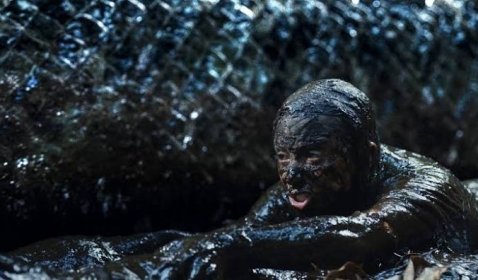
There are several genuinely nasty creatures, and some of the film's practical-looking effects give the monsters a physicality that makes them more disturbing than generic digital zombies.
Interestingly, the film also moves beyond the traditional zombie formula.
The undead are certainly part of the nightmare, but Cregger is more interested in the wider monster mythology surrounding Resident Evil. The result gradually becomes less of a straightforward zombie movie and more of a creature-feature nightmare.
That shift may divide audiences expecting a familiar outbreak story, but it gives the reboot its own identity.
More importantly, it feels closer to the spirit of the games.
The film never directly adapts one particular Resident Evil storyline. Instead, it borrows the experience of playing the games: exploring unfamiliar rooms, collecting information, figuring out where to go next and wondering why opening one seemingly harmless door is always such a terrible idea.
Cregger even structures the story like a game without making the comparison painfully obvious.
Bryan moves from one location to another, with each environment offering a new threat. The tension comes partly from knowing that something worse is probably waiting in the next area.
It is a simple formula, but it works.
The movie's biggest weakness arrives toward the end.
For most of its runtime, Bryan's gradual transformation from helpless courier to someone capable of confronting the nightmare is one of the film's strongest ideas. Unfortunately, the final stretch does not fully deliver on that character development.
After spending so much time making Bryan feel like a real person rather than a traditional action protagonist, the film seems to run out of interest in completing his journey.
It is not a disastrous ending, but it feels abrupt.
There is also a sense that some of the film's ideas are introduced more for atmosphere than substance. The monsters are memorable, the locations are creepy and the action is energetic, but the emotional implications of what Bryan encounters are not explored as deeply as they could have been.
That is perhaps the unavoidable trade-off of making such a fast-moving movie.
At around 90 minutes, Resident Evil is remarkably economical. There is little unnecessary exposition and very little time spent explaining decades of franchise history. For newcomers, that is welcome. You do not need to know every character, virus or corporation from the games to understand what is happening.
For longtime fans, meanwhile, there are enough familiar elements to make the experience feel connected to the source material without turning the entire movie into an Easter-egg hunt.
That restraint is one of the film's smartest decisions.
After so many adaptations that struggled under the weight of their own mythology, this Resident Evil feels refreshingly uncomplicated.
It wants you to be scared.
It wants you to laugh.
It wants you to watch Bryan make a terrible decision and then immediately regret it.
And then it wants to throw a monster at him.
That simplicity gives the movie momentum.
Cregger's previous films have demonstrated a talent for manipulating audience expectations, and while Resident Evil is less psychologically ambitious than Barbarian or Weapons, his command of pacing remains evident. The film rarely gives the audience enough time to settle comfortably before something goes wrong again.
The result is a horror movie that feels almost like a theme-park ride.
There are scares, gore, jokes, monsters and moments of ridiculousness arriving one after another. It is not interested in slowing down to deliver a profound meditation on humanity's relationship with technology or biological disaster.
Sometimes, thankfully, a horror movie can just be a horror movie.
There are moments when the humour threatens to weaken the atmosphere, and some of the supporting characters are not given enough room to become particularly memorable. But Abrams provides enough emotional grounding to keep the whole thing from becoming empty spectacle.
His performance is the film's secret weapon.
Bryan isn't cool.
He isn't particularly brave.
He isn't even especially competent.
But he tries.
That makes his survival strangely satisfying.
Cregger's Resident Evil may not completely reinvent the franchise, but it does something perhaps more valuable: it understands why the original games were so entertaining. The fear comes from vulnerability. The fun comes from exploration. And the absurdity comes from putting ordinary people in situations that would make anyone question their life choices.
The film's biggest achievement is making that formula feel fresh again.
It is bloody without becoming exhausting, funny without turning completely into parody, and faithful to the spirit of the games without simply copying them.
There are rough edges, particularly in the final act, and the story could have given Bryan's character arc a more satisfying conclusion. But for most of its running time, Resident Evil delivers exactly what its title promises.
A bad night.
A worse city.
And an absolutely terrible place to make one last delivery.
Rating: ★★★★☆ (4/5)
Do you like it? Let's share it!

NOW SHOWING




COMING SOON