Runner — Fast, Loud, and Just Self-Aware Enough to Survive
There is something almost reassuring about a movie like Runner. You know exactly what you are getting: a reluctant hero, a ridiculous mission, heavily armed villains, impossible escapes, and enough explosions to make common sense feel entirely optional. The only real question is whether the film can make that familiar formula entertaining.
Fortunately, Runner mostly can.
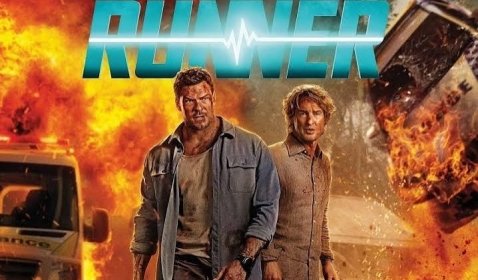
Directed by Scott Waugh, the action thriller stars Alan Ritchson as Hank Malone, an ex-military fixer living a relatively quiet life in Australia. His latest assignment sounds simple enough: transport a donor liver to a hospital so it can be given to a desperately ill child. Naturally, nothing goes according to plan.
Before long, Hank is caught in a violent chase involving mercenaries, criminals and Owen Wilson's Ben Bishop, whose involvement turns the supposedly straightforward delivery into something much bigger and considerably more chaotic.
The premise is absurd. The movie knows it.
That self-awareness is probably what keeps Runner from collapsing under the weight of its own clichés.
Ritchson is perfectly suited to this kind of role. He has the physical presence of a traditional action star, but Hank is not written as an invincible superhero. He is tired, damaged and clearly carrying baggage from his past. Ritchson gives the character enough seriousness to make the emotional moments work, even when the screenplay is busy throwing another gunfight or car chase at him.
The more surprising element is Owen Wilson.
Wilson's comic timing gives the film a welcome change of rhythm, particularly when the action starts becoming overly serious. His character is not exactly groundbreaking, but Wilson understands that Runner works better when it allows itself to be a little ridiculous. His presence gives the movie some of the buddy-action energy it occasionally needs.
The villains, meanwhile, belong to a completely different movie—and that is not necessarily a criticism.
Rodrigo Santoro plays Damian Zaldívar, a cartel figure whose motivations become increasingly melodramatic as the story develops. The character is so exaggerated that the film occasionally feels closer to an action-comedy parody than a conventional thriller.
Some viewers may find that tone entertaining. Others may wonder why the movie cannot simply commit to being a serious action film.
The action itself is the strongest reason to keep watching.
Scott Waugh stages the set pieces with plenty of momentum, and Runner rarely sits still for long. Vehicles crash, characters get thrown around, bullets fly and the laws of physics are treated more like suggestions than rules. It is excessive, but there is a certain pleasure in watching a film that has no interest in pretending its stunts are remotely ordinary.
The problem is that spectacle can only carry a movie so far.
Once the explosions stop, the weaknesses in the screenplay become much easier to see. The emotional material is fairly thin, and the characters rarely feel as complicated as the film wants them to be. Hank's troubled past is there mainly to give his heroism a little more weight, while the story's moral stakes are repeatedly underlined instead of being allowed to develop naturally.
There is also a familiar feeling running through almost every major development. Characters appear when the plot needs them. Villains behave exactly as expected. The heroes survive situations that should have ended the movie several times over.
None of this is particularly surprising for an old-fashioned B-movie, but it does prevent Runner from becoming more memorable than the average action thriller.
What saves it is the pace.
At around 98 minutes, the film knows better than to overstay its welcome. There is very little time for the story to become genuinely tedious, and even its weaker moments tend to move quickly into another chase, confrontation or ridiculous twist.
That economy matters. A more ambitious version of Runner might have tried to deepen the characters or give the central relationship more emotional weight, but it might also have lost the straightforward energy that makes this version reasonably enjoyable.
There is something almost charming about how shamelessly conventional the film is.
It is not trying to reinvent the action genre. It is not interested in delivering a profound examination of violence or heroism. It simply wants to put Alan Ritchson in dangerous situations, surround him with increasingly unreasonable obstacles and let the audience enjoy the ride.
And sometimes that is enough.
Still, Runner occasionally mistakes noise for excitement. The bigger action sequences are fun, but the quieter scenes rarely leave much of an impression. The movie has the ingredients for a genuinely entertaining action-comedy, yet the screenplay never quite finds the personality necessary to elevate it above its familiar influences.
The result is a film that is easy to watch and even easier to forget.
Ritchson makes a convincing action lead, Wilson provides some welcome humor, and the stunt work gives the movie enough energy to justify its existence. But underneath the gunfire and high-speed chaos is a story we have seen many times before.
Runner does not need to be taken seriously to be enjoyable. In fact, taking it too seriously may be the quickest way to ruin the experience. It works best when treated as a knowingly ridiculous piece of action entertainment—a fast, violent, occasionally funny B-movie that understands exactly how little it needs to accomplish.
It is not great filmmaking, and it is certainly not a reinvention of the genre.
But for 98 minutes, Runner keeps moving.
And sometimes, that is the whole point.
Rating: ★★★☆☆ (3/5)
Do you like it? Let's share it!



NOW SHOWING






COMING SOON