& Sons — A Family Drama of Brilliant Performances and a Twist That Can’t Quite Carry the Weight
There is something immediately compelling about a family drama built around secrets. Bring estranged relatives into the same room, add years of resentment and unanswered questions, and eventually someone is bound to say something that changes everything. & Sons begins with exactly that kind of promise. What follows is a story that is bold, strange and undeniably ambitious, even if its most intriguing ideas never quite develop into the emotional knockout they could have been.
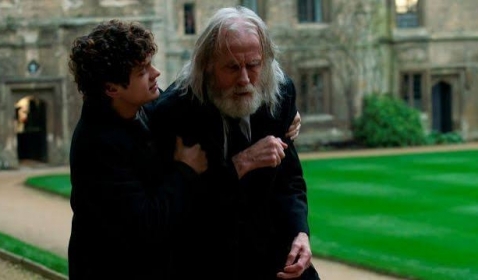
Based on David Gilbert’s novel, the film centres on Andrew Dyer, an acclaimed but deeply troubled novelist played by Billy Nighy. Once a towering literary figure, Andrew has spent years retreating from both his work and his family. His life has become a cycle of isolation, alcohol and anger, with his youngest son Andy, played by Noah Jupe, serving as his only regular connection to the outside world.
When Andrew unexpectedly invites his estranged sons Jamie and Richard back home, the reunion initially appears to be an opportunity for reconciliation. The two brothers, who have spent years disconnected from their father, arrive believing that perhaps age and time have finally softened him. But Andrew has something else in mind, and an early revelation sends the story in a completely unexpected direction.
That twist is undoubtedly the film's strongest weapon.
It arrives early enough to reshape the audience's understanding of what & Sons is trying to be, transforming what initially seems like a conventional British family drama into something far more unusual. The less viewers know about it beforehand, the better. It is a genuinely intriguing narrative turn, one that raises fascinating questions about identity, legacy, memory and the stories families tell themselves to survive.
Unfortunately, the film never fully capitalises on the potential of that idea.
The screenplay introduces several rich themes—fatherhood, generational trauma, artistic legacy and the search for identity—but often seems uncertain about which one it wants to explore most deeply. Instead of allowing these ideas to build toward something powerful, the story frequently circles around them. Important emotional questions are raised, only to receive surprisingly little development later on.
The pacing is another problem. & Sons takes its time establishing the emotional damage within the Dyer family, but that patience does not always translate into dramatic tension. Several scenes feel as though they are waiting for the story to reveal another layer, yet the eventual payoff is not always substantial enough to justify the slow build. By the final act, the film leaves behind a number of unresolved threads and a sense that its central message has remained frustratingly out of reach.
Thankfully, the cast gives the material considerably more weight than the screenplay sometimes deserves.
Billy Nighy is exceptional as Andrew. He has always been capable of finding vulnerability beneath sharp dialogue and eccentric behaviour, and & Sons gives him plenty of opportunities to explore both sides of that talent. Andrew can be cruel, unpredictable and deeply selfish, but Nighy never allows him to become a simple monster. There are glimpses of regret and loneliness beneath his destructive behaviour, making him fascinating even when he is difficult to sympathise with.
Imelda Staunton is equally impressive. Her performance brings emotional authority to the film, and she makes a lasting impact even when the script does not give her character as much room as it should. Staunton and Nighy share the kind of screen presence that can elevate an ordinary scene simply through a glance or a carefully delivered line.
Among the younger cast, Noah Jupe, George MacKay and Johnny Flynn all deliver strong performances. Jupe brings a quiet sensitivity to Andy, while MacKay and Flynn effectively portray the emotional distance between two brothers who have spent too long living with the consequences of their father's decisions. Still, the younger actors are occasionally underserved by the writing, which gives them interesting emotional conflicts without always allowing those conflicts to reach their full potential.
That is ultimately the central frustration of & Sons.
There is clearly a more powerful film hidden inside this one. The premise is intelligent and the early narrative twist gives the story an unpredictable edge. The cast is excellent, and the film repeatedly touches on ideas that could have made it a truly memorable drama. But the deeper the story goes, the less confident it seems about where it wants to arrive.
The ending, in particular, feels underwhelming after such an ambitious setup. Rather than bringing the film's emotional and thematic questions into focus, it leaves too much suspended. Ambiguity can be powerful when it feels intentional, but here it occasionally comes across as unfinished.
Even so, & Sons is not without its rewards. Its performances are consistently strong, its premise is genuinely original and there are enough compelling moments to make the journey worthwhile. It is a film that asks interesting questions about who we are, what we inherit from our families and whether the stories we believe about ourselves can ever truly be trusted.
It simply doesn't find enough satisfying answers.
& Sons is a thoughtful and ambitious family drama with a twist strong enough to grab your attention and a cast talented enough to keep you watching. But despite all of its promising ingredients, the film struggles to turn its complex ideas into a fully satisfying whole. It is fascinating in moments, frustrating in others, and ultimately feels like a story that had far more to say than it ever manages to express.
Rating: ★★★☆☆ (3/5)
Do you like it? Let's share it!




NOW SHOWING



COMING SOON