The End of Oak Street — When Suburbia Meets Prehistory, the Result Is Strange, Thrilling, and Surprisingly Human
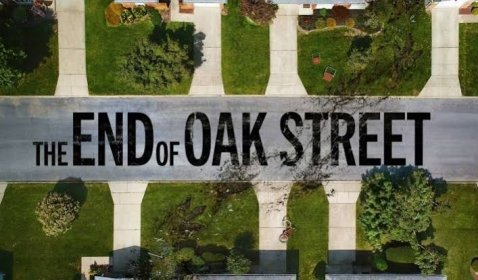
David Robert Mitchell has never been a filmmaker particularly interested in giving audiences straightforward answers. From It Follows to Under the Silver Lake, his movies have found unease in ordinary places, turning familiar environments into something mysterious and unsettling. The End of Oak Street takes that instinct and gives it a much bigger playground: an ordinary suburban neighborhood suddenly finds itself surrounded by the prehistoric world.
It sounds like the setup for a conventional dinosaur blockbuster. It isn't quite that.
Set in an early-1980s suburban community, the film follows the Platt family—Denise, Greg and their two children, Audrey and Brian—as their already-fragile family life is interrupted by an inexplicable cosmic event. Their neighborhood is transported into a prehistoric environment, leaving the residents to figure out what happened while trying to survive among dinosaurs and other ancient creatures.
The premise is easily the movie's strongest selling point. There is something inherently entertaining about seeing an ordinary suburban street transformed into a survival zone. Familiar houses, backyards and roads suddenly become places of genuine danger. Mitchell makes good use of that contrast, allowing the audience to recognize the environment before gradually turning it into something almost alien.
Anne Hathaway gives the film its emotional center. As Denise, she plays a mother whose relationship and family are already under considerable strain before the dinosaurs arrive. Hathaway avoids turning Denise into a generic action heroine. Her character remains frightened, uncertain and emotionally exhausted, which makes her eventual determination feel more convincing.
Ewan McGregor is similarly effective, although Greg is given less emotional complexity than Denise. The relationship between the two characters gives the film an additional layer beyond the creature-feature mechanics, suggesting that the real crisis isn't simply what's happening outside the house. There are problems within the family that the prehistoric disaster merely forces them to confront.
Maisy Stella and Christian Convery are particularly natural as Audrey and Brian. Their performances help ground the more fantastical elements of the story, making the Platts feel like an actual family rather than four characters waiting for the next dinosaur attack.
Visually, The End of Oak Street is impressive without becoming completely dependent on spectacle. Mitchell's framing frequently gives the suburban environment an eerie sense of scale, while the dinosaurs provide the expected bursts of excitement. There is a clear affection for the adventure films of the 1980s, particularly the Spielbergian tradition of combining family drama with extraordinary circumstances.
That nostalgia, however, is also where the film occasionally becomes predictable.
There are moments when The End of Oak Street feels like a collection of familiar ingredients from better-known movies. The suburban setting, children in danger, mysterious cosmic phenomenon and prehistoric creatures are all appealing individually, but the combination doesn't always feel as original as the premise initially suggests. Some critics have argued that the film's Spielberg-inspired qualities can make it feel derivative rather than transformative.
The screenplay also has its share of questionable decisions. Characters occasionally behave in ways that seem designed to create another action sequence rather than because their choices make sense. Some of the mythology surrounding the central phenomenon remains intentionally vague, but there are moments when that ambiguity feels less intriguing and more frustrating.
Fortunately, the film's pacing keeps those weaknesses from becoming overwhelming. At around 99 minutes, it doesn't overstay its welcome. The story moves quickly from family drama to survival thriller, giving the audience enough time to appreciate the characters without allowing the dinosaur sequences to become repetitive.
What makes The End of Oak Street work better than its premise might suggest is its sincerity. Beneath the dinosaurs and science-fiction mystery is a story about a family that has already begun falling apart. The extraordinary circumstances force them to reconsider what they mean to one another, giving the spectacle an emotional purpose rather than simply using dinosaurs as decoration.
It isn't flawless, and viewers looking for a completely original reinvention of the creature-feature genre may come away disappointed. But there is enough atmosphere, strong acting and old-fashioned adventure spirit here to make the film considerably more enjoyable than its familiar ingredients might suggest.
The End of Oak Street isn't the next Jurassic Park, nor does it need to be. It works best when it stops trying to live up to its influences and simply embraces the strange little world David Robert Mitchell has created.
It's a nostalgic, occasionally uneven, but genuinely entertaining piece of sci-fi adventure—one that reminds us that sometimes the most frightening thing isn't discovering a dinosaur in your backyard, but discovering how fragile the life you've built really is.
Rating: ★★★½☆ (3.5/5)
Do you like it? Let's share it!



NOW SHOWING





COMING SOON