The Last Whale Singer — Finding a Voice Beneath the Waves
There is something immediately appealing about The Last Whale Singer. A young whale, a magical song, an endangered ocean and a gigantic sea monster emerging from melting ice—it's the kind of premise that seems designed to send children on a colourful adventure while quietly teaching them a few lessons about courage, grief and protecting the natural world.
Fortunately, the film has enough heart to make those lessons feel more sincere than they might sound on paper.
Directed by Reza Memari, Pavel Hrubos and Steven Majaury, The Last Whale Singer follows Vincent, a young humpback whale who grows up under the shadow of his father Humphrey, a legendary Whale Singer whose magical voice has the power to heal and protect the ocean.
Vincent, however, doesn't feel particularly heroic.
After losing his parents, he struggles with grief and the fear that he will never be able to live up to his father's legacy. When a terrifying creature escapes from beneath a melting iceberg and begins threatening marine life, Vincent is forced to confront exactly the thing he has spent most of his life avoiding: himself.
It is a familiar coming-of-age story, but the underwater setting gives it a pleasant sense of scale.
The film's biggest strength is undoubtedly its animation.
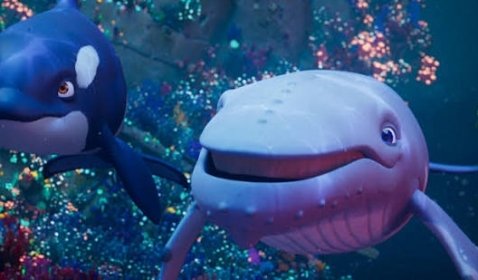
The ocean is presented as a huge, colourful world filled with glowing plants, unusual sea creatures and enormous whales moving through the water with an almost dreamlike quality. There is a real sense of effort behind the visual design, and the filmmakers clearly want the audience to feel as though they are exploring a world rather than simply watching characters move through a series of backgrounds.
The underwater sequences are often beautiful.
They also give the film an opportunity to shift between bright, playful environments and darker locations where the mood becomes considerably more threatening. When the sea monster appears, the film suddenly feels much more dangerous, and some of its imagery can be surprisingly intense for a children's movie.
That tonal contrast works better than expected.
Vincent is also an easy character to root for.
He isn't introduced as an instantly confident hero. Quite the opposite. His uncertainty is the defining part of his personality, and his fear of disappointing his father gives the adventure an emotional foundation.
Vincent Tong brings a gentle quality to the character, allowing Vincent's insecurity to feel believable without making him unnecessarily gloomy.
His journey is less about becoming the strongest whale in the ocean than understanding that he doesn't have to become his father.
That is an important distinction.
The film's message about finding your own voice is hardly new, but it is presented in a way that younger viewers should understand. Vincent spends much of the story comparing himself to someone who came before him, only to discover that his own strengths may look completely different.
For adults, the metaphor is obvious.
For children, it could be genuinely useful.
Bruce Dinsmore provides much of the comic relief as Walter, Vincent's loyal suckerfish companion and caretaker. Walter is fussy, nervous and protective, giving the film a lighter personality whenever Vincent's story becomes too heavy.
Their relationship is one of the movie's more enjoyable elements because it feels affectionate rather than purely functional. Walter isn't simply there to deliver jokes; he genuinely cares about Vincent and wants to keep him safe.
The supporting characters also help make the journey feel larger.
Vincent encounters a colourful collection of marine creatures as he travels through different parts of the ocean, and the film uses these encounters to introduce younger audiences to different forms of marine life.
That educational quality never completely takes over the story, which is a relief.
The environmental message is obvious, but The Last Whale Singer generally avoids turning into a lecture. Human damage to the ocean, melting ice and pollution are part of the film's larger mythology, but the story remains focused primarily on Vincent's personal journey.
Still, the environmental themes could have been developed more subtly.
At times, the movie seems to underline its message simply because it wants to make sure nobody misses it. The story would have been stronger if some of those ideas had been allowed to emerge naturally from the adventure rather than being so clearly presented as lessons.
The screenplay is similarly familiar.
There are echoes of countless animated adventures about young heroes following in the footsteps of legendary parents. The basic structure—loss, self-doubt, friendship, dangerous journey and eventual discovery of inner strength—is hardly unfamiliar territory.
What separates The Last Whale Singer from those films is not necessarily the originality of the story.
It is the sincerity.
The movie genuinely believes in its characters and themes, and that enthusiasm is difficult to dislike.
There are also some surprisingly dark moments beneath the colourful surface. Vincent's grief is not simply treated as a temporary obstacle that disappears once the adventure begins. His parents' deaths continue to influence how he sees himself, and the film is willing to acknowledge that moving forward doesn't mean forgetting the people you've lost.
That gives the story more emotional weight than its simple plot might suggest.
Unfortunately, the middle section loses some of that momentum.
The film occasionally wanders into strange side adventures involving various ocean creatures, and not all of these detours feel equally important. Some are amusing, but others slow down the central story just when Vincent's journey should be gathering pace.
It makes the 91-minute running time feel longer than it actually is in a few places.
The movie also struggles to make its villain particularly memorable.
The giant sea creature looks impressive and provides plenty of danger, but it functions more as an obstacle than as a fully developed threat. Once Vincent's personal story becomes the focus, the monster begins to feel like a mechanism designed to push him toward his destiny.
That is perfectly acceptable for a family adventure, but it prevents the conflict from becoming especially compelling.
The music, however, fits the concept nicely.
Since singing is central to the mythology of the Whale Singers, the songs aren't simply decorative additions. They are part of the film's emotional language, helping Vincent gradually understand what his voice means and why it matters.
There is something rather sweet about that idea.
The film doesn't tell Vincent that he needs to become louder.
It tells him that he needs to find his own song.
That distinction gives the familiar message a little more personality.
The Last Whale Singer is also clearly aimed at families, and that should be kept in mind when judging its simplicity. The film isn't trying to compete with the complexity of a Pixar drama or the visual ambition of the biggest animated blockbusters.
It wants to introduce younger audiences to a magical ocean world and give them a hero who feels vulnerable before he becomes brave.
On those terms, it succeeds.
It is colourful, accessible and emotionally straightforward.
It also has enough darker imagery and moments of peril to prevent the adventure from becoming completely weightless. Vincent's journey involves genuine danger, and the film isn't afraid to remind its audience that the ocean can be beautiful and frightening at the same time.
The result is a movie that doesn't necessarily break new ground, but rarely feels cynical about the ground it is covering.
There is a genuine warmth running through it.
Vincent's relationship with Walter, his memories of his parents, his fear of failure and his eventual discovery of his own ability all contribute to a simple but effective emotional arc.
By the end, the message is clear: you don't honour someone you love by becoming exactly like them.
Sometimes, you honour them by becoming yourself.
That is a lesson The Last Whale Singer delivers with considerable sincerity.
The film's familiar story structure, occasional pacing problems and uneven supporting material keep it from becoming something truly exceptional. But the animation is lovely, the central character is sympathetic and the environmental themes give the adventure a purpose beyond simply defeating a monster.
It may not be the most original animated film you'll see this year.
But originality isn't the only measure of a good family movie.
Sometimes a film simply needs to give children a character they can understand, a world they want to explore and an idea they might carry with them after the credits.
The Last Whale Singer does exactly that.
Its biggest achievement isn't the magical song that saves the ocean.
It is convincing Vincent—and perhaps the audience—that finding your own voice can be more important than living in someone else's shadow.
Rating: ★★★½☆ (3.5/5)
Do you like it? Let's share it!

NOW SHOWING





COMING SOON