The Paradise — When Rage Speaks Louder Than the Story
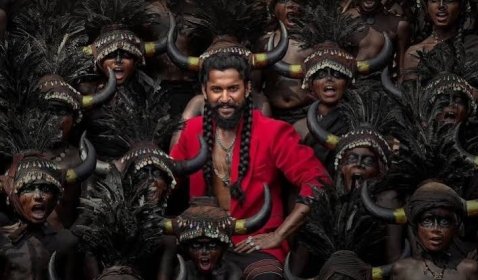
The Paradise arrives with the kind of premise that should carry considerable emotional weight. Set in the 1980s, the film follows a marginalised nomadic community living under the brutal control of a powerful local ruler, while a son returns home after years in prison and finds himself caught between personal resentment, family history and the struggle for his people's dignity.
It is a story about oppression, resistance, motherhood and the complicated burden of becoming a leader.
Unfortunately, The Paradise often seems far more interested in showing us its violence than making us feel the pain that supposedly drives it.
Directed by Srikanth Odela, the film reunites him with Nani following Dasara. Nani plays Jadal, a man who returns to Paradise after spending 14 years in prison, carrying a deep anger toward his mother Sammakka, played by Sonali Kulkarni. She was one of the first members of their community to openly demand recognition and dignity for her people.
Jadal initially wants revenge against Shikanja Maalik, the authoritarian figure who has kept the community under his control. But the situation becomes more complicated when Shikanja's son, Vikram Malik, begins pursuing a political career.
What begins as a personal story gradually becomes a larger battle for an entire community.
There is a potentially powerful movie buried inside that premise.
The problem is that The Paradise rarely gives its emotional material enough room to breathe.
Nani clearly commits himself to the role. Jadal looks and behaves dramatically different from the more familiar characters the actor has played in the past. There is an intensity to his performance, particularly during the physical confrontations, and he carries the film's enormous action sequences with convincing physicality.
But intensity isn't the same thing as emotional depth.
Jadal's hatred toward his mother is supposed to be one of the film's central emotional engines. His eventual understanding of her struggle should transform the way we see him and explain why he decides to fight for the community.
Instead, the screenplay often rushes through the emotional connection.
We understand what Jadal is angry about.
We understand what Sammakka wants.
We understand why the community needs someone to stand up for them.
What is missing is the feeling between those points.
That becomes increasingly noticeable whenever the film shifts into action.
And there is a lot of action.
The Paradise is not shy about violence. Limbs are severed, bodies are burned and characters are subjected to brutal punishments. The bloodshed is presented with an almost relentless enthusiasm, sometimes becoming so graphic that the violence begins to overwhelm everything surrounding it.
The strange part is that the film doesn't reserve this brutality exclusively for its villains.
Jadal himself becomes an instrument of extreme violence.
That creates an interesting moral possibility, but the screenplay doesn't really explore it. Instead, violence is frequently presented as spectacle, and the emotional consequences are pushed into the background.
As a result, the action can become exhausting rather than cathartic.
There are sequences that look impressive, but the question remains: what are we supposed to feel?
That is where the film struggles most.
The production itself is considerably stronger.
CH Sai's cinematography gives the 1980s setting an appropriately gritty and expansive appearance. The world of Paradise feels harsh and lived-in, and the large-scale production design gives the story the visual weight of a period epic.
There is clearly a lot of money and effort on screen.
The problem is that technical scale cannot compensate for an underdeveloped emotional foundation.
Anirudh Ravichander's music is similarly enormous. The score frequently arrives at full volume, pushing scenes toward intensity even when the material itself hasn't earned that emotional escalation.
There are moments when the music feels less like an accompaniment and more like another character demanding attention.
A little restraint would have helped.
The villains are also uneven.
Mohan Babu initially creates an imposing presence as Shikanja Maalik. His character has the potential to become a genuinely frightening representation of unchecked power, particularly because of the control he has over the community.
Yet the film gradually shifts its attention toward his son Vikram Malik, played by Raghav Juyal.
That transition never feels completely convincing.
Shikanja is established as the central source of oppression, only for the narrative to increasingly reposition his son as the primary threat. The younger villain has his moments, but the film doesn't provide enough development to make that change feel dramatically necessary.
It feels more like the screenplay is moving pieces around because the story needs a new opponent.
The women in the story are another missed opportunity.
Sammakka should be central to the film's emotional architecture. Her struggle for recognition provides the foundation for Jadal's eventual transformation, yet the movie frequently treats her more as a symbol than as a fully developed character.
Kayadu Lohar's Subbalakshmi, meanwhile, has a romantic subplot with Jadal that never becomes particularly essential to the larger story.
There is nothing inherently wrong with giving the protagonist a love interest, but here it feels like another thread competing for attention in an already crowded narrative.
The film simply has too many things it wants to be.
A revenge drama.
A family tragedy.
A political story.
A social drama.
A period action movie.
A story about leadership.
Each idea has potential, but they don't always fit together naturally.
The first half is more concerned with Jadal's anger and his complicated relationship with his mother, while the second half turns increasingly toward his transformation into a leader. In theory, that structure makes sense.
In practice, the transition is too abrupt.
Jadal suddenly begins carrying the hopes of his people, but the movie doesn't spend enough time showing how he earns their trust or develops into someone capable of leading them.
The character changes because the plot requires him to change.
That makes his eventual heroism feel less satisfying than it should.
There are still individual moments that work.
A few action sequences have genuine impact. The cinematography gives the film a distinctive visual identity, and Nani's commitment to such a physically demanding role is difficult to dismiss.
The film also deserves credit for attempting to tell a story about a community whose struggle for recognition is rarely placed at the centre of mainstream action cinema.
There is something worthwhile in that ambition.
Unfortunately, ambition alone cannot hold a movie together.
The Paradise repeatedly reaches for something powerful but settles for something louder. Instead of allowing its themes of oppression, family and resistance to build organically, it often announces them through violence, dramatic music and larger-than-life confrontations.
The result is a film that feels angry without always feeling deeply emotional.
And that distinction matters.
A movie about people fighting for dignity should make us understand what has been taken from them. A movie about a son finally understanding his mother's sacrifice should make that relationship hurt.
The Paradise tells us these things.
It doesn't always make us feel them.
That is ultimately why the film's strongest moments are visual rather than emotional. The production looks expensive, the action is unapologetically brutal and Nani gives everything to Jadal.
But once the blood has been cleaned from the screen and the music stops pounding, there isn't quite enough character development underneath it all.
The Paradise is not without ambition, and it certainly isn't a timid film. It wants to make a statement about power, oppression and resistance while delivering the kind of massive action spectacle audiences expect from a contemporary Indian period drama.
The ingredients are there.
The execution is much less convincing.
There are flashes of a far more affecting film buried beneath the noise—a story about a son who finally understands his mother, a community demanding recognition and a man discovering that leadership means carrying someone else's pain as well as his own.
That movie might have been extraordinary.
The one we get is mostly a bloody, visually impressive and emotionally distant action drama.
Nani takes a considerable risk with The Paradise, and the film certainly looks like one.
Unfortunately, the risk doesn't always translate into something rewarding.
Rating: ★★☆☆☆ (2/5)
Do you like it? Let's share it!

NOW SHOWING




COMING SOON