Wild Horse Nine — A Beautifully Bitter Journey into the Ruins of Friendship and Conscience
Martin McDonagh has always been fascinated by people who are difficult to like but impossible to ignore. His characters are often cruel, profane, self-destructive, and capable of surprising tenderness when they least expect it. In Wild Horse Nine, the filmmaker returns to familiar territory with a darkly comic story about two CIA operatives whose long careers in political violence have left them facing uncomfortable questions about loyalty, morality, and the lives they have wasted.
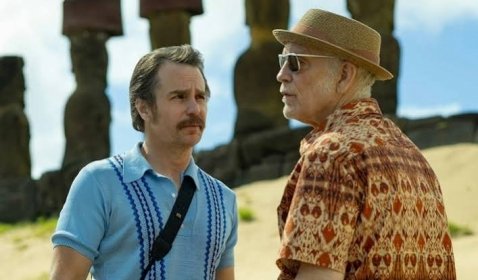
Set shortly before the 1973 Chilean coup, the film follows veteran agents Chris (John Malkovich) and Lee (Sam Rockwell), who are sent from Santiago to Easter Island by their station chief, MJ (Steve Buscemi). What initially resembles a strange assignment in a remote paradise gradually becomes something more complicated. Surrounded by the island's monumental stone statues and vast Pacific landscapes, the longtime partners must contend with old resentments, present-day conspiracies, and the consequences of the work they have spent their lives doing.
Chris's growing connection with two rebellious Chilean students, Monica (Mariana di Girolamo) and Alicia (Ailín Salas), further unsettles the mission. Their presence introduces perspectives that challenge the agents' assumptions, exposing the distance between the democratic ideals they claim to defend and the ruthless methods they employ. The resulting story is less a conventional spy thriller than a character study of men who have become very good at justifying the unjustifiable.
McDonagh is not interested in making these characters easy to forgive. Chris and Lee have participated in the machinery of American intervention, and the film does not pretend that their crimes can be erased by a few moments of reflection. Instead, it finds dark comedy in their casual cynicism, their petty arguments, and their apparent inability to discuss anything without turning it into a contest of wit. Their conversations can be hilarious, but the humour carries an unpleasant aftertaste because the men delivering the jokes have spent their lives inflicting real damage on others.
This is where Wild Horse Nine is most effective. Its comedy is not simply a collection of outrageous lines or shocking insults. It reveals how easily cruelty can become ordinary when people surround themselves with others who share their assumptions. Chris and Lee have developed a language of mockery that allows them to avoid confronting the meaning of their actions. They can talk endlessly about politics, history, religion, and death, yet the most important questions remain stubbornly unresolved.
The film's sharpest irony lies in the contrast between the agents' supposed mission and the reality of their work. They regard themselves as defenders of democracy, but their profession requires them to interfere with the very political choices they claim to protect. McDonagh approaches this contradiction through sardonic dialogue rather than a conventional political lecture. Sometimes the approach is devastatingly funny; at other times, the jokes threaten to overwhelm the seriousness of the history behind them.
The setting gives these arguments an especially compelling backdrop. Easter Island, or Rapa Nui, is more than a picturesque location for two weary men to exchange insults. Its immense moai statues seem to watch over the characters with an inscrutable stillness, creating a striking contrast with the agents' restless talk and moral evasions. Cinematographer Ben Davis captures the island's open landscapes and monumental figures with a sense of scale that makes Chris and Lee appear small against the history surrounding them.
The imagery also lends the film a quiet melancholy. These are men who have travelled widely and exercised power across borders, yet they seem incapable of finding peace anywhere. Their temporary refuge becomes a place where the past follows them, and the island's beauty only makes their internal ugliness more apparent. The wild horses that appear throughout the film reinforce its interest in freedom, instinct, and the difficulty of controlling what refuses to be domesticated.
Visually, Wild Horse Nine is among McDonagh's more evocative works. The film moves between broad, almost meditative landscapes and intimate scenes in which the characters' faces become the most important scenery. Davis understands when to let the environment speak for itself and when to close in on the tension between two people who know each other too well. Carter Burwell's score complements this approach, adding emotional depth without constantly telling the audience what to feel.
Still, the film's greatest asset is its central pairing. Malkovich gives Chris a wonderfully peculiar mixture of intelligence, arrogance, and physical vulnerability. His character can be insufferable, but there is something compelling about the way he uses conversation as both entertainment and defence. He speaks as though every subject in the world belongs to him, yet his confidence occasionally slips, revealing a man increasingly conscious of his mortality and uncertain about what his life has amounted to.
Rockwell's Lee provides an effective counterweight. Where Chris is expansive and unpredictable, Lee is more restrained, though his patience has limits. Rockwell brings a twitchy, watchful quality to the role, suggesting a man who has learned to anticipate Chris's next provocation while remaining unable to detach himself from their relationship. Their exchanges feel lived-in rather than mechanically constructed, and even the smallest gestures can suggest years of shared experiences, private jokes, and accumulated resentment.
Their chemistry is the film's beating heart. Beneath the insults and philosophical detours lies a complicated friendship that neither man knows how to express without disguising it as antagonism. McDonagh has explored similarly volatile relationships before, particularly in In Bruges and The Banshees of Inisherin, but the dynamic here feels shaped by age and regret. Chris and Lee are no longer simply men arguing about who is right. They are men beginning to realise that the life they built together may be the only life they know how to live.
Buscemi adds another welcome layer of menace and absurdity as MJ, while Parker Posey and Tom Waits make memorable contributions in smaller roles. The supporting performances help flesh out a world in which personal relationships are often strained by secrets, professional obligations, and the characters' inability to communicate honestly. Nevertheless, the film belongs primarily to Malkovich and Rockwell, whose scenes together are consistently more engaging than the plot's more elaborate manoeuvres.
That emphasis on character comes with a cost. At 118 minutes, Wild Horse Nine takes its time, allowing conversations to wander and confrontations to develop at their own pace. For admirers of McDonagh's writing, this looseness is part of the pleasure. A seemingly irrelevant exchange may suddenly reveal a disturbing truth or lead to an unexpectedly moving moment. But not every digression earns its place, and the film occasionally mistakes verbal cleverness for forward movement.
Its political dimension is similarly uneven. The backdrop of the impending Chilean coup gives the story genuine historical weight, yet the film is often more interested in the personal dilemmas of its American protagonists than in the people affected by their actions. Monica and Alicia introduce an important challenge to the agents' worldview, but their perspectives sometimes feel secondary to the men's philosophical sparring. This creates an uncomfortable imbalance: a film concerned with the consequences of imperial power can still end up giving its perpetrators the most room to explain themselves.
That tension is not necessarily a flaw in the concept. McDonagh is clearly interested in the moral evasions of men who can acknowledge their cynicism without ever fully abandoning it. However, the film could have pushed further into the consequences of that contradiction, allowing the political history to exert more pressure on the personal drama. Instead, some of its sharpest observations remain tantalisingly underdeveloped.
The humour will also divide audiences. McDonagh's dialogue is deliberately abrasive, full of profanity, provocations, and jokes that flirt with offensiveness. At its best, the language exposes the characters' prejudices and emotional cowardice. At its weakest, it becomes a familiar performance of male irreverence, with the sheer volume of insults threatening to make every exchange sound alike. Viewers who have never warmed to the filmmaker's particular brand of black comedy are unlikely to be converted here.
Yet the film's willingness to let unpleasant people remain unpleasant is part of what makes it interesting. Wild Horse Nine does not offer a neat moral awakening or pretend that recognising one's failures is the same as making amends. Its characters may occasionally glimpse the emptiness of their lives, but insight arrives late, and the possibility of redemption remains uncertain. The film's bleakest observation is that people can understand what they have become without necessarily finding the courage to change.
By the end, the film feels less like a conventional espionage story than a long, uncomfortable conversation about mortality and regret. The conspiracies matter, but the deeper conflict concerns two men who have spent so much time serving institutions and defending their own behaviour that they barely know how to exist outside those roles. Their friendship offers companionship, but it also binds them to the very history they might wish to escape.
Wild Horse Nine is not as tightly controlled as McDonagh's best work, and its political ambitions sometimes struggle to keep pace with its fascination for its central duo. Nevertheless, the performances are exceptional, the setting is striking, and the dialogue delivers enough wickedly funny moments to sustain the film through its slower passages. More importantly, beneath its cynicism is a genuine sadness about people who discover the cost of their choices only when there is little time left to do anything about them.
This is a film that will reward viewers who enjoy morally complicated characters, long stretches of dialogue, and comedy that leaves a bruise. It may frustrate those looking for a sharply plotted thriller or a more balanced examination of Chile's political tragedy. But for all its digressions and excesses, Wild Horse Nine has a lingering power. Its characters may be experts at lying to everyone around them, yet their greatest deception is the one they have practised on themselves.
Rating: 4/5
Do you like it? Let's share it!
NOW SHOWING



COMING SOON